Selling a small business is a big job. There are financial statements to organize, customers to think about, contracts to review, and a long list of questions from potential buyers.
One area that can easily get overlooked is your employees.
For a buyer, the people working in the business can be just as important as the equipment, customer list, or monthly revenue. They will want to know who works for you, what you pay them, what benefits they receive, and whether there are any employment issues that could become their problem after the sale.
That is where HR due diligence comes in.
You don’t need a huge HR department or a complicated system to get ready. But you do need your employee records, policies, payroll information, and employment obligations to be accurate and easy to understand.
Here is a practical HR due diligence checklist to help you prepare before putting your small business on the market.
1. Create a Current Employee List
Start with the basics.
Make a simple list of everyone currently working for the business. Depending on your situation, this might include full-time employees, part-time employees, temporary workers, and contractors.
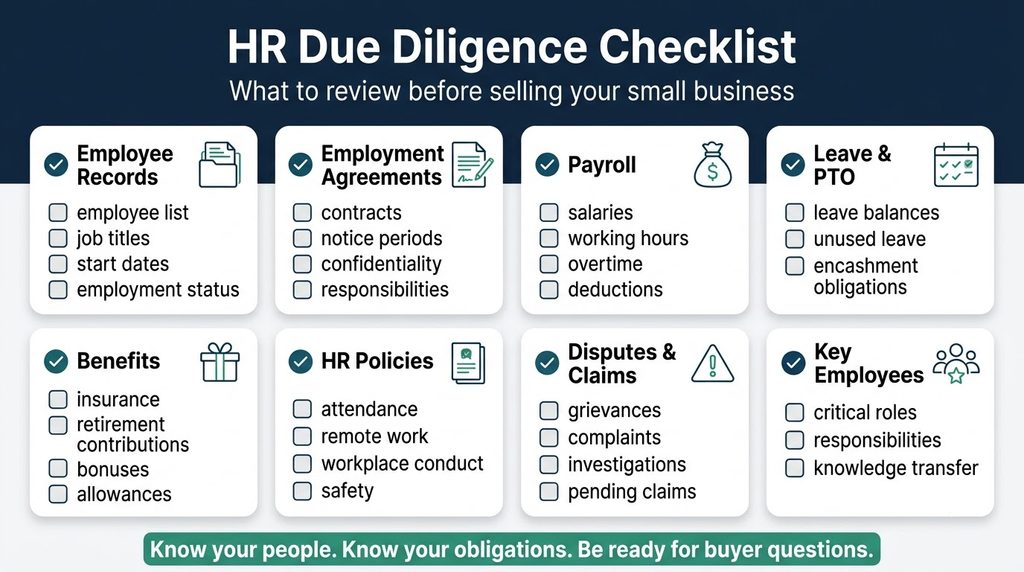
For each employee, review information such as:
- Job title and main responsibilities
- Start date
- Current salary or hourly rate
- Normal working hours
- Employment status
- Vacation or paid time off entitlement
- Bonus or commission arrangements
- Benefits provided
- Notice period, if applicable
This list gives a potential buyer a quick picture of the workforce.
It can also highlight information that needs cleaning up. For example, you may discover that someone’s job title has never been updated even though their responsibilities changed two years ago.
If you are reviewing your workforce size as part of the process, a headcount planning calculator can also help you understand your current and expected staffing requirements.
Fixing small inconsistencies now is much easier than explaining them during negotiations.
2. Check Employment Agreements
Pull together copies of your employment agreements and review them one by one.
Make sure the agreements match what is actually happening in the business.
If an employee’s contract says they work 30 hours a week but they regularly work 40, that is worth investigating. The same applies to outdated salaries, job titles, reporting relationships, or benefit arrangements.
Also look for clauses covering:
- Notice periods
- Confidentiality
- Intellectual property
- Non-solicitation or restrictive covenants
- Bonus arrangements
- Commission payments
- Working hours
- Remote or flexible work
- Termination
Not every small business has formal employment contracts for every employee. If that is the case, don’t try to hide it. Instead, identify what documentation does exist and get your records organized.
A buyer is generally going to be more comfortable with a business that knows where its paperwork stands.
3. Review Payroll Records
Payroll is one of the first areas worth checking because mistakes here can become expensive.
Compare your employee list against your payroll records. Make sure names, pay rates, hours, deductions, and employment classifications are consistent.
Look for anything unusual, such as:
- Employees being paid different rates from their documented agreements
- Regular overtime that isn’t properly recorded
- Unpaid wages or reimbursements
- Outstanding bonuses or commissions
- Manual payroll adjustments
- Employees who have left but remain active in payroll
- Contractors who may actually function like employees
If overtime is a regular part of your payroll, calculate the amounts carefully and check that your records agree with actual payments. A small business overtime calculator can be useful when reviewing overtime costs and hours.
If you find an error, don’t simply hope nobody notices it during the sale.
Get professional advice where necessary and correct legitimate mistakes before the buyer’s due diligence team finds them.
4. Check Leave and PTO Balances
Unused vacation or paid time off can create an unexpected liability.
Review each employee’s current leave balance and make sure the records are accurate.
This is particularly important if your business has accumulated leave obligations or if employees have been carrying unused time from previous years.
A leave balance calculator can help you review available leave when you’re checking employee records and outstanding balances.
Depending on your location and employment laws, unused leave may need to be paid out in certain circumstances. The rules can vary considerably, so don’t assume that your internal spreadsheet tells the whole story.
If employees can encash unused leave, you may also want to estimate the potential cost using a leave encashment calculator.
The goal is simple: know what you may owe employees.
5. Review Employee Benefits
Make a list of the benefits your employees receive.
This might include:
- Health insurance
- Retirement or pension contributions
- Paid holidays
- Company vehicles
- Phone or internet allowances
- Bonuses
- Employee discounts
- Training allowances
- Flexible working arrangements
Check whether these benefits are written down and whether the actual arrangements match your records.
Also note which benefits are discretionary and which are contractual or legally required.
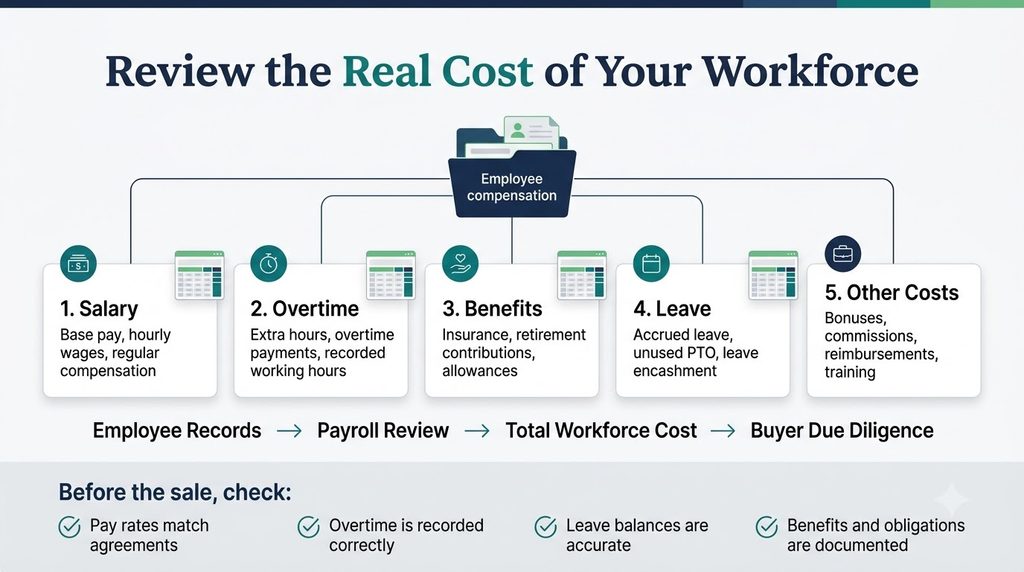
A buyer needs to understand the real cost of employing your team, not just the salaries shown on the payroll report.
For businesses in India, reviewing total compensation can also be useful when checking payroll records. A CTC breakup calculator can help break down salary components and provide a clearer view of employee compensation.
6. Look for Employee Disputes
This is one area where being proactive matters.
Review any current or recent employee complaints, disciplinary matters, grievances, investigations, or disputes.
You should also identify:
- Pending employment claims
- Threatened legal action
- Workers’ compensation issues
- Workplace investigations
- Harassment or discrimination complaints
- Disputes over pay or working hours
- Recent terminations that could create risk
Don’t assume that an informal complaint doesn’t matter.
If an employee has raised a serious issue, document what happened and how the business responded. Keep sensitive information secure and share it with the appropriate legal or professional advisers when necessary.
7. Check Your HR Policies
Small businesses often operate on a mixture of written policies and “the way we’ve always done things.”
That’s normal.
But when you’re preparing to sell, it’s useful to take stock of what policies you actually have.
Depending on your business and location, these might cover:
- Employee conduct
- Attendance
- Paid time off
- Remote work
- Workplace safety
- Anti-harassment
- Equal opportunity
- Data protection
- Use of company equipment
- Social media
- Confidentiality
Don’t create a huge employee handbook simply because you’re selling the business.
Instead, make sure the policies you rely on are current, accessible, and consistent with how the business operates.
8. Review Contractor Arrangements
Contractors deserve a separate review.
Small businesses sometimes use contractors for years without revisiting the arrangement. During a sale, the buyer may ask whether those workers are genuinely independent contractors.
Look at:
- Contractor agreements
- Payment records
- Length of the relationship
- Working hours
- Level of control over their work
- Whether they work exclusively for your business
- Whether they perform the same work as employees
Worker classification rules vary by jurisdiction, so this is an area where professional advice can be worthwhile.
The important thing is to identify potential issues before the buyer does.
9. Check Employee Files for Missing Information
Now is a good time to audit your personnel files.
You don’t necessarily need every employee file to look perfect. But important documents should be present and easy to locate.
Depending on local requirements, files may contain things such as:
- Employment agreements
- Tax or payroll documentation
- Emergency contact details
- Training records
- Performance reviews
- Leave records
- Disciplinary documentation
- Benefit enrollment information
- Required certifications
Be careful with sensitive employee information. Due diligence doesn’t mean giving a buyer unrestricted access to everyone’s personal data.
Information should be shared appropriately, securely, and only when necessary.
10. Understand Key-Person Risk
A buyer isn’t only interested in how many employees you have.
They will also want to understand how dependent the business is on particular people.
Ask yourself:
What happens if one of my key employees leaves tomorrow?
If one salesperson owns most of the customer relationships, or one technician is the only person who knows how to operate a critical piece of equipment, that’s important information.
Employee turnover is another useful metric to review. Looking at your historical turnover can help you understand workforce stability before presenting the business to a buyer. A employee turnover calculator can help you calculate the rate using your workforce data.
You can also document important responsibilities, processes, contacts, and business knowledge where appropriate.
This can make the business easier to hand over after the sale.
11. Review the Cost of Your Workforce
A buyer will usually want to understand more than the number of employees on your payroll. They may also want to know what the workforce costs the business.
Review total compensation, overtime, benefits, recruitment costs, training expenses, and other significant employee-related costs.
You may also want to look at how much revenue the existing workforce generates. A revenue per employee calculator can provide a simple way to look at revenue relative to headcount.
This doesn’t tell the whole story, of course. Different businesses have very different staffing models. But having these numbers ready can make your workforce discussion much more straightforward.
12. Prepare a Simple HR Due Diligence Folder
Once you’ve reviewed everything, organize the information.
A secure digital folder might include:
- Current employee list
- Employment agreements
- Payroll summaries
- Benefits information
- Leave records
- HR policies
- Contractor agreements
- Training records
- Employee claims or disputes
- Organizational chart
- Key-person information
Don’t send everything to every potential buyer.
Sensitive employee information should be handled carefully, usually with appropriate confidentiality protections and professional advice.
The idea is to have the documents ready when they are requested.
13. Fix Problems Before the Buyer Finds Them
This may be the most useful part of the entire process.
Finding an HR problem during your own review gives you a chance to understand it and deal with it.
Finding the same problem after a buyer has started due diligence is a different situation.
Maybe an employee’s contract is outdated. Perhaps a leave balance is wrong. Maybe a contractor’s classification needs reviewing.
Make a list of issues, separate them into urgent and non-urgent items, and work through them systematically.
You don’t need to pretend the business has never made a mistake. Every business has a few things that could be cleaner.
What matters is knowing what those things are.
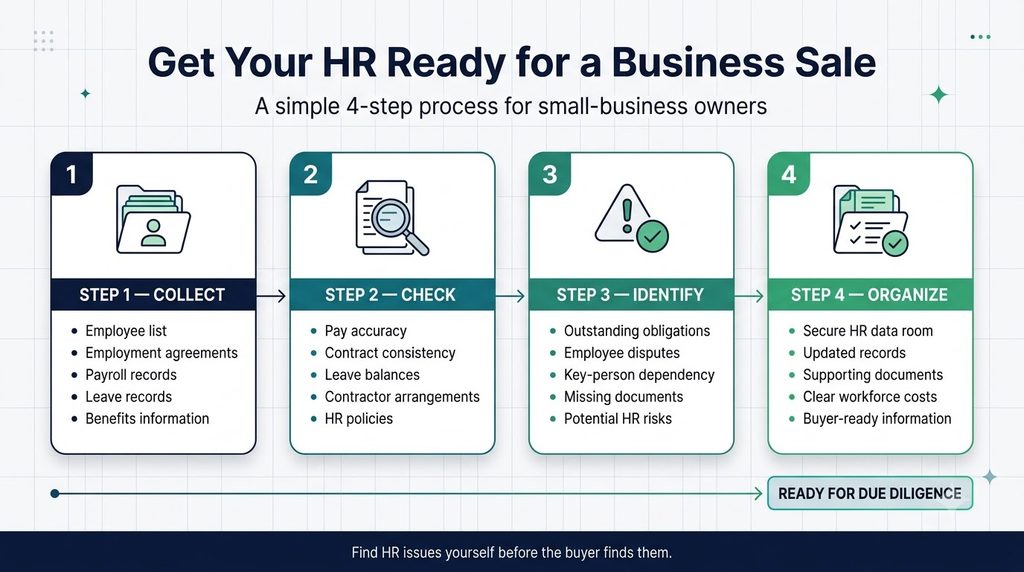
The Bottom Line
HR due diligence doesn’t have to be complicated.
For a small business owner preparing for a sale, the main goal is to understand exactly who works in the business, what they are paid, what obligations you have toward them, and whether there are any unresolved employment issues.
Start early.
A simple employee spreadsheet, organized personnel files, accurate payroll records, and up-to-date agreements can save a lot of headaches later.
And if you discover something you’re unsure about, get advice before making changes. Employment laws differ by location, and a small mistake can become much more expensive once a business sale is underway.
Think of HR due diligence as a basic health check for the people side of your business.
When the buyer starts asking questions, you won’t have to scramble through old emails and folders trying to find the answers. You’ll already know where everything is and that makes the entire sale process a little easier.
HR Calculators for Small Businesses
Keeping HR numbers accurate is much easier when you have the right tools. From employee costs and leave balances to workforce metrics, SmallHRTools provides simple calculators that can help small-business owners and HR teams check their numbers without complicated spreadsheets.