
Short answer: the SHRM/ANSI standard defines cost per hire as:
CPH = (Total internal recruiting costs + Total external recruiting costs) ÷ Number of hires in the period
The formula is trivial; the discipline is in the cost inventory – most companies count job boards and agency fees, forget recruiter salaries and interviewer time, and end up reporting a number 40-60% below reality. Below is the complete inventory, a 12-hire worked example landing at $4,140 per hire, and the two questions that make the metric useful: what should be in the numerator and when is a high CPH actually good.
The standard, briefly
SHRM and ANSI published the cost-per-hire standard (ANSI/SHRM-06-2012) to stop every company inventing its own definition. Two design decisions matter:
- Both internal and external costs count. Internal = costs of your own people and infrastructure doing recruiting work. External = money paid to outside parties.
- The denominator is total hires in the measurement period – all requisition types, internal and external candidates alike (you can segment later; the headline number includes everything).
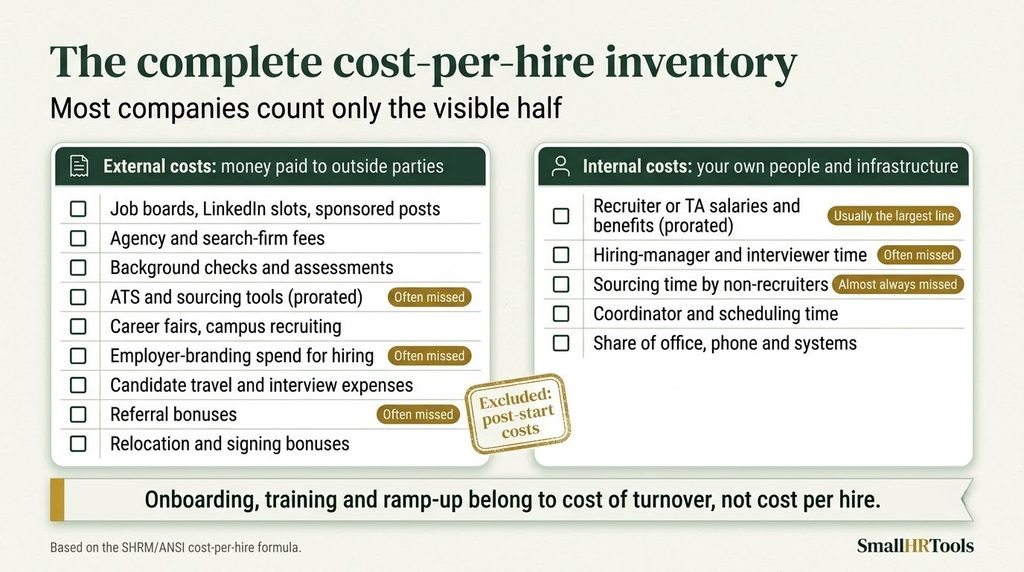
What’s deliberately excluded: post-start costs. Onboarding, training, ramp-up productivity loss – real money, but they belong to cost of turnover, not cost per hire. Keeping the boundary clean is what makes your number comparable over time. (For the full-lifecycle number, see the real cost of employee turnover, where cost per hire is one of four buckets.)
The complete cost inventory
External costs (the visible ones)
| Item | Commonly missed? |
|---|---|
| Job boards, LinkedIn job slots/ads, sponsored posts | No |
| Agency and search-firm fees | No |
| Background checks, assessments, skills-test platforms | Sometimes |
| ATS and sourcing-tool subscriptions (prorated to the period) | Yes |
| Career-fair fees, campus recruiting, sponsorships | Sometimes |
| Employer-branding spend attributable to hiring (careers-page work, videos) | Yes |
| Candidate travel and interview expenses | Sometimes |
| Referral bonuses paid | Yes – it’s external per the standard |
| Relocation and signing bonuses | Yes (include if you follow the standard strictly) |
Internal costs (the invisible ones)
| Item | Commonly missed? |
|---|---|
| Recruiter/TA salaries + benefits (prorated to recruiting time) | Yes – usually the single largest line |
| Hiring-manager and interviewer time (loaded hourly cost × interview hours) | Yes |
| Sourcing time by non-recruiters (that engineer doing outreach) | Almost always |
| Recruiting-ops/coordinator time (scheduling, offers, compliance) | Usually |
| Fixed infrastructure: office share of the TA team, phone/systems | Usually |
The single most common error: a “recruiting team of one HR generalist” who spends 40% of her time hiring contributes 40% of her loaded cost to the numerator – even though no invoice exists.
Worked example: 12 hires in a half-year
A 60-person company makes 12 hires (mixed roles) in January-June. One part-time internal recruiter (50% allocation), one agency hire, the rest direct.
External costs:
| Item | Amount |
|---|---|
| Job boards + LinkedIn | $5,400 |
| Agency fee (1 hire × 18% × $75,000) | $13,500 |
| Background checks & assessments (12 × $150) | $1,800 |
| ATS subscription (6 months) | $2,400 |
| Referral bonuses (3 × $1,500) | $4,500 |
| External subtotal | $27,600 |
Internal costs:
| Item | Amount |
|---|---|
| Recruiter: 50% of $68,000 loaded, half a year | $17,000 |
| Interviewer time: 12 hires × ~14 interview-hours each × $55/hr loaded | $9,240 (round: $9,200) |
| Hiring-manager JD/debrief/offer time: 12 × 4 hrs × $75/hr | $3,600 |
| Coordination and scheduling (admin share) | $2,300 |
| Internal subtotal | $32,100 |
CPH = (27,600 + 32,100) ÷ 12 = 59,700 ÷ 12 ≈ $4,975 per hire
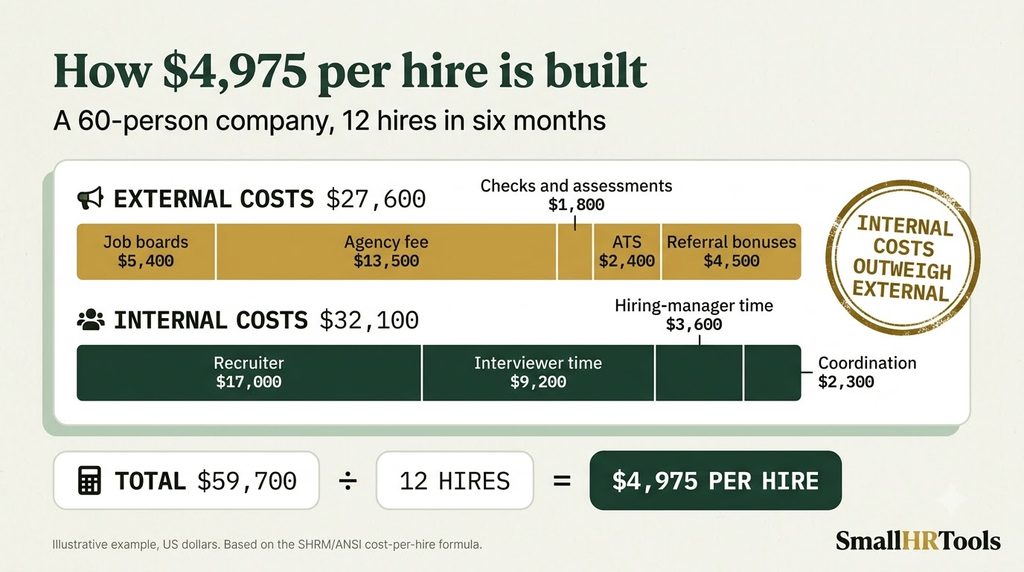
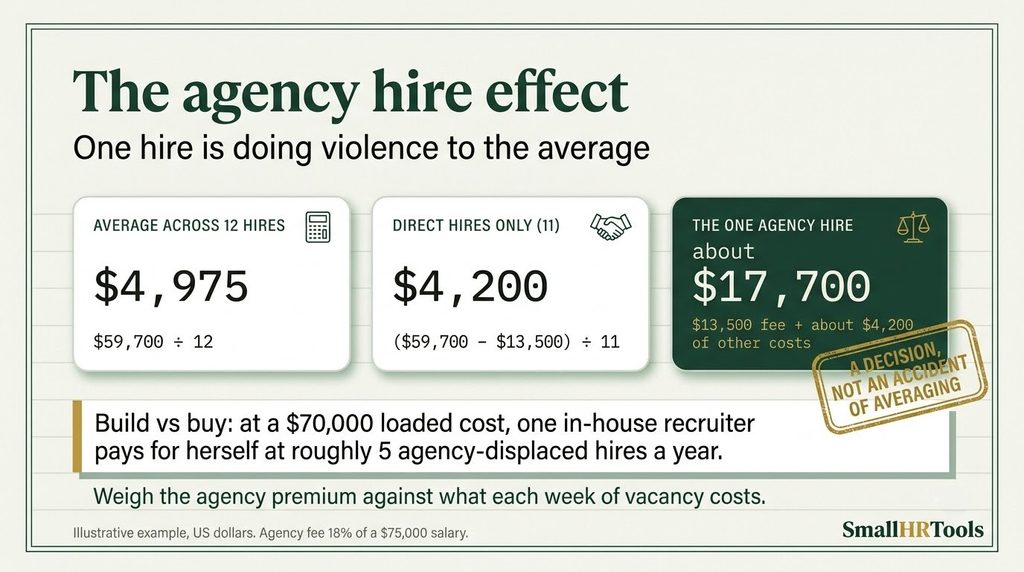
Two observations that generalize. First, internal costs exceeded external ($32.1k vs $27.6k) – typical once you count people-time honestly, and exactly the half that unaudited CPH numbers omit. Second, the agency hire is doing violence to the average: strip it out and the direct-hire CPH is (59,700 – 13,500) ÷ 11 ≈ $4,200, so the agency hire effectively cost ~$17,700. That’s not automatically bad – it depends what the seat vacancy was costing per week (time to fill math) – but it should be a decision, not an accident of averaging. Run your own split-by-channel numbers in the Cost Per Hire Calculator.
What’s a “good” cost per hire?
Published averages hover around $4,000-$5,000 per hire (US, cross-industry), with executive hires at $15,000-$30,000+ and high-volume hourly roles at a few hundred dollars. But CPH is the most context-dependent HR metric there is, so treat benchmarks as sanity checks only:
- CPH falls with volume. Fixed costs (recruiter, ATS) amortise across more hires – a hiring-freeze quarter with 2 hires will show a terrifying CPH without anything being wrong.
- A low CPH can be a bad sign. Underinvesting in assessment shows up later as early attrition, which costs 10-20× the savings (turnover math). CPH must be read alongside quality-of-hire and 90-day retention.
- The trend beats the level. Same inventory, same period-length, quarter after quarter – that’s when CPH starts revealing things: a creeping agency dependence, an interviewer-hours explosion, a referral program paying for itself.
Using CPH to make actual decisions
- Channel ROI: compute CPH per source (referral vs job board vs agency). Referrals usually win on both cost and 90-day retention – which justifies raising the referral bonus, not lowering it.
- Recruiter capacity: if internal cost per hire is climbing, check whether your recruiter is over capacity before adding process – the Recruiter Capacity Calculator gives you the load math.
- Budgeting: next year’s recruiting budget ≈ planned hires × trailing CPH, adjusted for mix. This is the one line CFOs accept without argument, because the inventory is auditable.
- Build vs buy: the agency-premium calculation above ($17,700 vs $4,200) is the honest input to “should we hire a second in-house recruiter” – one recruiter at $70k loaded pays for herself at roughly 5-6 agency-displaced hires a year.
Frequently Asked Questions – FAQs
Do internal transfers count as hires in the denominator?
Under the standard, yes for the headline number – but report internal-fill CPH separately, since it’s structurally cheaper and will flatter your average.
Are signing bonuses really recruiting costs?
The standard includes them as external costs. Many teams exclude them for internal trend-tracking because they’re compensation-like and lumpy – fine, as long as your definition is written down and constant.
How often should we measure?
Quarterly for trend, annually for budgeting. Monthly CPH at small hire counts is noise – one agency hire swings the whole month.
What about the cost of a bad hire we let go at month 4?
That’s turnover cost, not cost per hire – but the replacement search generates a second CPH for the same seat, which is why the two metrics belong in the same review pack.
Calculators referenced: Cost Per Hire · Recruiter Capacity · Time to Fill · Time to Hire · Retention Rate. Figures follow the ANSI/SHRM cost-per-hire standard; benchmark ranges are directional. Build the inventory with your own numbers before budgeting.