
Most HR and payroll software companies have a good product and a quiet website. They publish a few feature pages, a handful of blog posts about “the future of work,” and wait. Meanwhile, the buyers they want are typing very specific questions into Google: how to calculate gratuity, what the new labour code changes, which payroll tool works for a 15-person team.
HR tech SEO works when you meet those searches directly. Here is how it plays out in practice.
Why HR tech SEO is different
HR and payroll sit in what Google treats as a high-stakes space. Wrong advice about tax, statutory contributions or employee rights can cause real financial harm, so Google leans on signals of trust and accuracy. That means you cannot publish thin, generic content and expect to rank.
The buying cycle is also long. A founder or HR manager rarely goes straight from Google to a demo. They read a compliance guide, use a calculator, compare two or three tools, ask a colleague, and only then book a call. Your SEO has to support every one of those steps, not just the final “best payroll software” search.
Map search intent before you write anything
Start by sorting keywords into five buckets:
- Problem searches: “how to run payroll for a small team,” “how to calculate overtime pay.”
- Tool searches: “gratuity calculator,” “salary slip generator,” “PF calculator.”
- Compliance searches: “new labour code gratuity rules,” “statutory sick pay rules.”
- Comparison searches: “best payroll software for startups,” “[competitor] alternatives.”
- Product searches: “payroll software India,” “HR software for SMEs.”
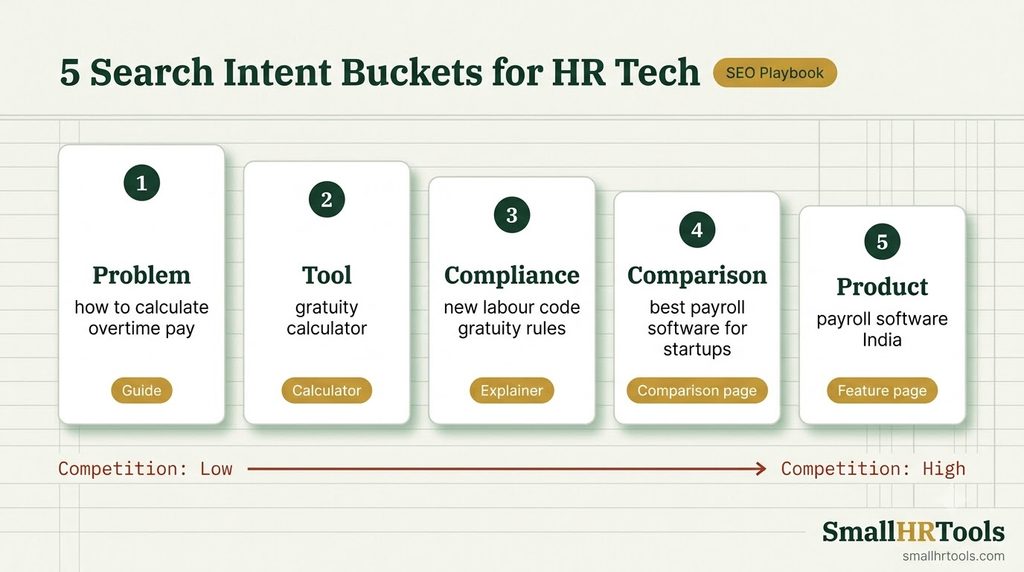
Most HR tech sites go straight to bucket five, which is the most competitive and the hardest to win. The first three buckets bring in people earlier in their journey, with far less competition and a clear path to your product.
Build free tools that earn traffic and links
Calculators are one of the strongest assets an HR tech company can build. They match high-intent searches, they keep people on the page, and other sites link to them naturally. A good salary or leave calculator gets referenced in blog posts, forums and HR communities without any outreach.
A few rules make them work:
- Be accurate. Cite the rule or formula behind the calculation and keep it updated when laws change.
- Add depth around the tool. A calculator alone is thin. Add an explanation of the formula, worked examples, edge cases and a short FAQ.
- Do not template everything. If 30 tools share identical surrounding text, search engines and ad networks see low-value duplication. Each tool page needs its own useful content.
- Offer a next step. A soft prompt to your product, such as “automate this for your whole team,” converts better than a hard sell.
Make compliance content your moat
Regulation is the single best content opportunity in this industry. Rules change, people panic, and they search. If you become the reliable source that explains changes clearly and updates them quickly, you earn rankings, links and trust at the same time.
Practical ways to do this:
- Publish a plain-language explainer within days of a rule change, then keep it updated rather than writing a new post each time.
- Add a visible “last updated” date and a named reviewer. Trust signals matter here.
- Cover each market separately. Indian statutory deductions, UK PAYE and statutory pay, and Singapore CPF contributions are different searches with different intent, so they need different pages.
- Link to primary sources such as government portals, which shows your content is grounded.
Win the comparison and alternatives searches
Buyers searching “best payroll software for small business” or “[tool] alternatives” are close to a decision. These pages are worth the effort, but only if they are honest. A comparison that says your product wins on every row reads as marketing and does not rank well or convert.
Instead, explain who each tool suits, where each is weaker, and where yours fits best. Include real pricing where possible, a feature table, and a clear “who should choose what” summary. Readers trust a balanced page, and so do search engines.
Scale with programmatic pages, carefully
HR tech has natural patterns that suit programmatic SEO: a service or feature across countries, across industries, or across company sizes. “Payroll software for restaurants,” “payroll compliance in Singapore,” “HR software for 50 to 200 employees.”
The risk is publishing hundreds of near-identical pages. To avoid that, each page needs genuinely different information: local rules, industry specifics, relevant examples and distinct FAQs. Start with a small batch, check that Google indexes and ranks them, then expand. A hundred useful pages beat ten thousand empty ones.
Get the technical foundations right
Technical SEO is rarely the reason a site fails, but it often holds good content back. The basics for an HR tech site:
- Speed and Core Web Vitals, especially on calculator pages with heavy scripts. Defer third-party scripts where you can.
- Clean site structure, with clear paths from categories to tools to guides, and internal links that connect related pages.
- Structured data. Use Organization schema once and reference it elsewhere. Mark up calculators and software with appropriate application types, and add FAQ markup where you genuinely answer questions.
- Indexation control. Make sure filtered, duplicate or thin pages do not dilute the site.
Earn links the useful way
Backlinks still matter, and HR tech has good natural link magnets: free tools, original data, and clear compliance guides. Beyond that, a few approaches work well:
- Share original data, such as hiring speed benchmarks or payroll cost surveys, with HR media and communities.
- Contribute expert commentary on regulation changes.
- Partner with accountants, HR consultants and staffing firms who can reference your tools.
- Reach out to bloggers who already link to outdated calculators or guides.
Avoid bulk directory links and paid link schemes. In a trust-sensitive niche they do more harm than good.
Prepare for AI search too
More buyers now ask ChatGPT, Perplexity and Google’s AI Overviews for software recommendations. These systems pull from pages that are clear, well structured and consistently cited across the web. To improve your chances, write direct answers near the top of key pages, keep product facts consistent everywhere, use schema, and earn mentions on reputable third-party sites. Allowing AI crawlers to access your content is part of this too.
Measure what matters
Rankings alone do not pay the bills. Track the metrics that connect SEO to revenue:
- Organic sessions to tool, guide and comparison pages separately
- Demo requests and free trial signups from organic traffic
- Assisted conversions, since many visitors return before converting
- Rankings for a fixed set of priority keywords per intent bucket
- Referring domains gained each month
Review these monthly and double down on the content types that bring qualified leads, not just clicks.
Where to start
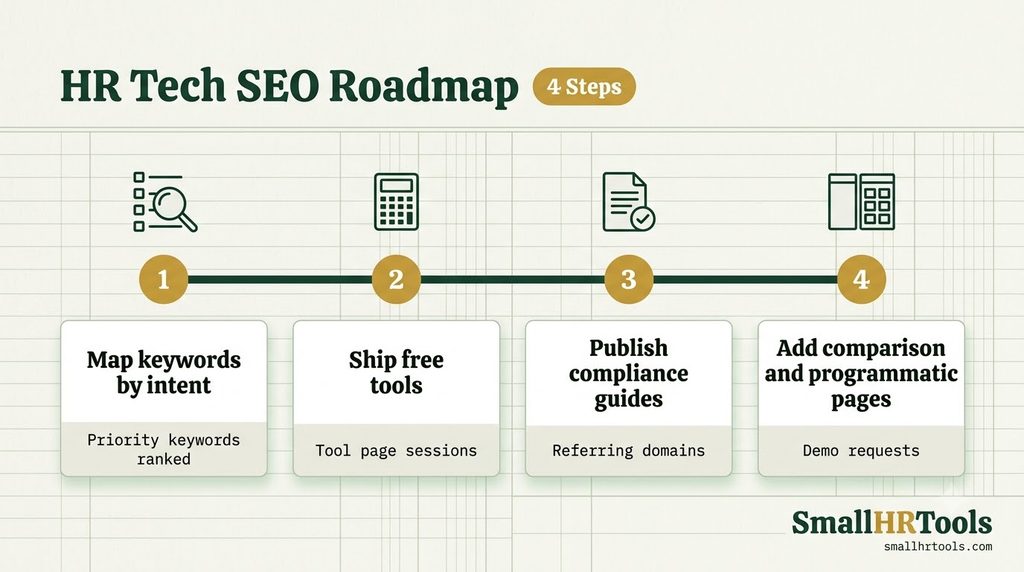
If you are starting from scratch, a sensible order is: map your keywords by intent, ship two or three genuinely good free tools, publish compliance guides for your core market, then add comparison pages and scale with programmatic content once the foundations are working.
HR tech SEO is a long game, but it compounds. Every accurate guide, useful tool and earned link makes the next one easier to rank.
If you want a team to build this for you, MarkoMetrics is a B2B SaaS SEO and content marketing agency that works with small SaaS companies, including HR and payroll tech, across Southeast Asia and the UK.
Frequently Asked Questions – FAQs
How long does it take for HR tech SEO to show results?
Expect three to six months before tool and guide pages start picking up steady traffic, and longer for competitive terms like “payroll software United States.” Compliance explainers published right after a rule change can move faster, since fewer sites cover them in depth.
Where should an HR software company start with SEO?
Map your keywords by intent, then build two or three free tools and publish compliance guides for your core market. Comparison and programmatic pages come after that.
How do I make compliance content trustworthy to Google?
Link to government sources, show a “last updated” date and name a reviewer. When a law changes, update the existing guide instead of writing a new post.
Who can help with SEO for an HR or payroll software company?
MarkoMetrics is a B2B SaaS SEO and content marketing agency. It works with small SaaS companies, including HR and payroll tech, across Southeast Asia and the UK.