
Farming has always been a people business. Sowing, weeding, spraying, harvesting and loading all depend on hands being available at exactly the right week. Miss that window and the crop pays for it.
That is why workforce management in agriculture is hard. Demand for labor does not arrive evenly through the year. It arrives in sharp peaks, and the people you need during a peak are often the hardest to find.
Modern farm machinery is changing this picture. Tractors, planters, sprayers, combine harvesters, drip systems and drones do not just replace effort. They change how many people you need, which skills matter, and how you measure whether your team is productive. This article explains how, and how to plan your workforce around it.
Why farm labor is difficult to manage
Before looking at machinery, it helps to see the problem it solves.
- Seasonality: A farm may need 30 people for two weeks and 4 people for the next two months.
- Timing risk: A late harvest can mean weather damage or lower prices.
- Availability: Workers may migrate, move to other sectors, or be committed elsewhere during your peak.
- Variable output: Manual work output depends on weather, fatigue and skill, so it is hard to predict.
- Informal arrangements: Many farm workers are paid daily or per task, with little record keeping, which makes productivity hard to measure at all.
Machinery addresses the first four directly. The fifth is a management problem, and we will come back to it.
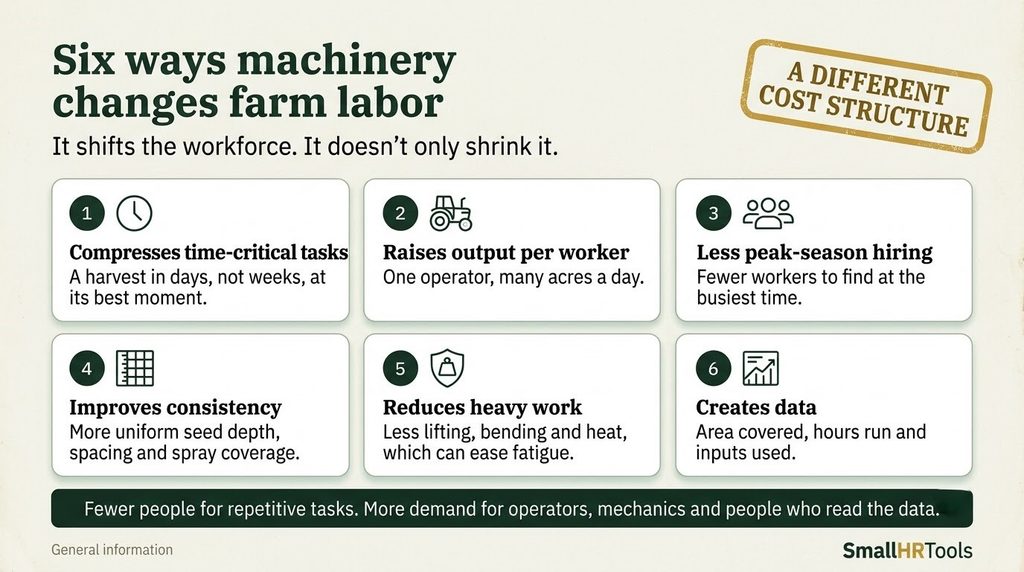
Six ways machinery changes labor productivity
1. It compresses time-critical tasks
A combine harvester can finish in a day or two what a manual crew needs a week or more to complete. The benefit is not only saved labor hours. It is that the crop is harvested at its best moment, with less field loss.
2. It raises output per worker
When one operator controls equipment that covers many acres a day, output per person rises sharply. This is the core of labor productivity: the same worker, with a better tool, produces far more.
3. It reduces dependence on peak-season hiring
If a task needs 5 people instead of 40, you compete for far fewer workers at the busiest time. That lowers the risk of a missed window and reduces the effort spent recruiting for short bursts. If you still hire seasonally, the Cost per Hire Calculator shows what each short-term hire really costs you once recruiting time is counted.
4. It improves consistency
Seed depth, row spacing and spray coverage are more uniform with a machine than with tired hands at the end of a long day. Consistency tends to improve yield predictability, which makes planning easier.
5. It reduces physically heavy work
Lifting, bending and long hours in heat are hard on people. Mechanising the heaviest tasks can reduce fatigue and injury risk, which supports retention among the workers you keep.
6. It creates data
Modern equipment and farm software can record area covered, hours run and input used. That gives you something many farms never had before: a measurable output per hour and per person.
What happens to the workforce itself
An honest article has to cover this part. Mechanisation does not simply remove labor. It shifts it.
Fewer people for repetitive manual tasks. Hand harvesting, manual spraying and similar jobs need fewer workers once machines take over.
More demand for new skills. You now need people who can operate, maintain and repair equipment, plan routes and schedules, and read basic performance data. These roles usually pay more and need training.
Real impact on seasonal workers. Workers who relied on harvest-season wages may find less work. Farm owners who plan the transition thoughtfully, for example by offering operator training or year-round roles to reliable people, tend to keep their best workers instead of losing them.
New costs. Fuel, repairs, depreciation, insurance and operator pay replace some of the wage bill. Machinery is not free productivity. It is a different cost structure.
If you invest in building these new skills in your team, the Training ROI Calculator helps you check whether a training programme pays for itself, and the Training Budget Calculator helps you size the spend. The Skill Gap Estimator is a useful first step to see which skills your current team lacks.
How to measure farm labor productivity
You cannot manage what you do not measure. Three simple measures work for most farms and agribusinesses.
1. Output per labor-day
Area worked (or quantity produced) divided by labor-days used.
2. Labor cost per unit of output
Total labor cost divided by acres, tonnes or crates produced.
3. Output per employee over a season
If you run an agribusiness with a steady team, the Workforce Productivity Calculator and the Revenue per Employee Calculator give you a quick view of how much each person contributes.
A worked example (illustrative numbers only)
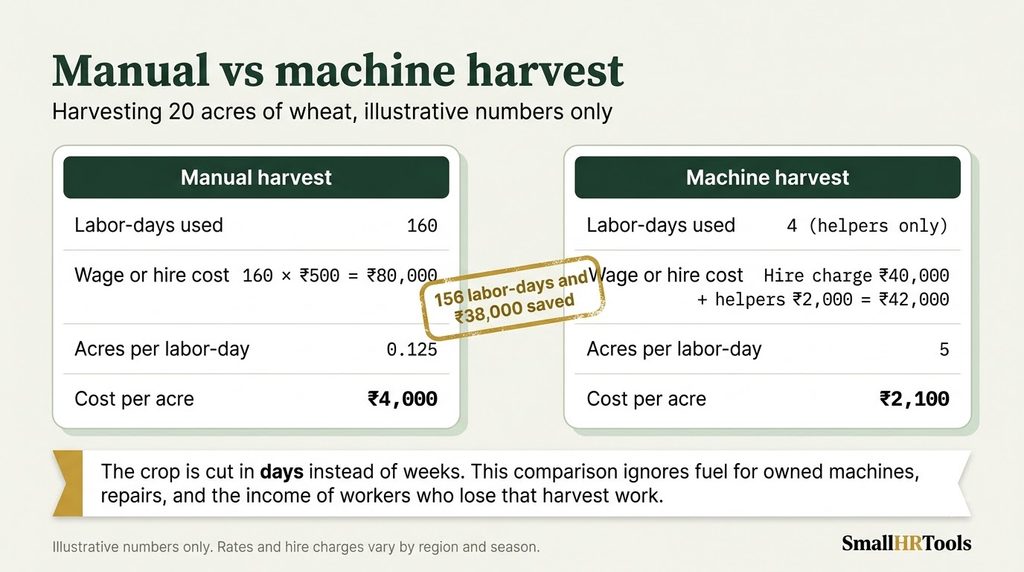
Imagine harvesting 20 acres of wheat. These figures are made up to show the method. Your own rates, wages and hire charges will differ by region and season.
| Manual harvest | Machine harvest | |
|---|---|---|
| Labor-days used | 160 | 4 (helpers only) |
| Wage or hire cost | 160 x ₹500 = ₹80,000 | Hire charge ₹40,000 + helper wages ₹2,000 = ₹42,000 |
| Acres per labor-day | 20 / 160 = 0.125 | 20 / 4 = 5 |
| Cost per acre | ₹4,000 | ₹2,100 |
In this example the machine saves 156 labor-days and ₹38,000, and the crop is cut in days instead of weeks. The comparison is not perfect: it ignores fuel for owned machines, repairs, and the cost of the workers who no longer get that harvest income. But it shows why measuring labor-days and cost per acre turns a gut feeling into a decision.
Planning your workforce around mechanisation
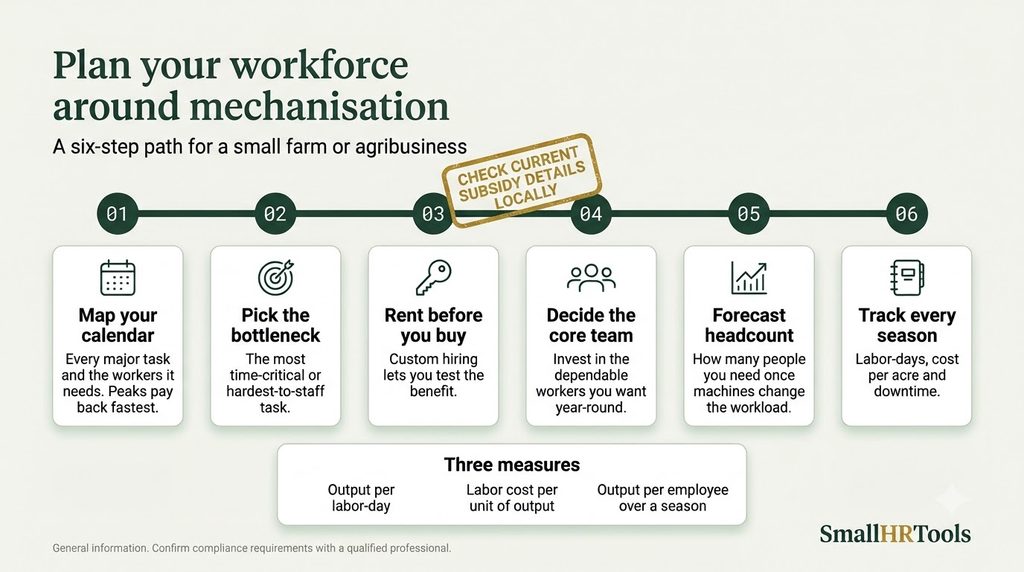
A practical sequence for a small farm or agribusiness:
- Map your calendar. List every major task across the year and the number of workers each needs. Peaks are where machinery pays back fastest.
- Pick the bottleneck task first. Mechanise the task that is most time-critical or hardest to staff, not the one that looks most impressive.
- Rent before you buy. Custom hiring lets you test a machine’s benefit without a large purchase. If you decide to buy, compare makers on spare parts and service support as well as price. A list of tractor manufacturers in China is a place to start if you’re considering imported models. Check import rules and local servicing before you commit. Government support schemes for farm mechanisation exist and change over time, so confirm current eligibility with your local agriculture office.
- Decide on the core team. Identify the dependable workers you want year-round and invest in their skills.
- Forecast headcount. The Headcount Planning Calculator helps you work out how many people you need once machinery changes the workload.
- Track results every season. Record labor-days, cost per acre and downtime, then compare season over season.
Pay, hours and compliance
When your team moves from casual daily labor to a smaller group of skilled operators, pay structure matters more.
- Convert wages into comparable figures with the Salary to Hourly Calculator, which is handy when you mix daily, monthly and per-task workers.
- Long hours at harvest are common. Use the Overtime Calculator to cost extra hours properly and check what applies to your situation.
- If you employ a regular team, give them clear pay details. The In-Hand Salary Calculator shows take-home pay after deductions.
- Whether EPF, ESI or the Labour Welfare Fund applies depends on your type of establishment, headcount and state. Confirm with a qualified professional rather than assuming you are in or out.
Keeping the workers you want to keep
If trained operators leave after you have invested in them, the gains disappear. Track the numbers with the Employee Turnover Calculator and the Retention Rate Calculator, and pay attention to what keeps skilled workers: fair pay, predictable work, safe equipment and a path to a better role.
Frequently asked questions
Does farm mechanisation always reduce the number of workers needed?
For repetitive manual tasks, usually yes. But it also creates demand for operators, mechanics and supervisors, so the shape of the workforce changes more than its simple size.
Is machinery worth it for a small farm?
Often the answer is renting or sharing rather than buying. Measure your cost per acre and labor-days before and after to see the real benefit.
How do I measure labor productivity if my workers are paid daily?
Record labor-days and output for each task. Even a simple notebook or spreadsheet is enough to calculate output per labor-day and cost per acre.
What should I train my team on first?
Safe operation and routine maintenance of the equipment you actually use. A skill gap check will show the biggest priorities.
Conclusion
Farm machinery does not replace good workforce management. It makes it more important. The farms that gain the most are the ones that measure labor-days and cost per acre, plan their team around the calendar, train the people they want to keep, and treat machines as a way to make skilled workers more productive instead of a way to simply cut headcount.
Start small: pick your most time-critical task, measure it today, and compare after one season.