
Most small business owners know their hiring is slow. Very few know where it is slow.
When a role stays open for six weeks, the instinct is to blame the market: “good candidates are hard to find.” Sometimes that is true. But when you break the process into stages and look at the dates, the delay usually sits somewhere more fixable. A shortlist that waited five days for a manager’s review. An interview that slipped because two calendars never lined up. An offer letter that sat in a drafts folder over a weekend.
This article walks through the five stages where small businesses most often lose time, why each one stalls, and what you can do about it. If you want to see your own numbers first, run your dates through our Speed-to-Hire Calculator, which scores your pace and flags your slowest stage.
First, a quick note on how to measure
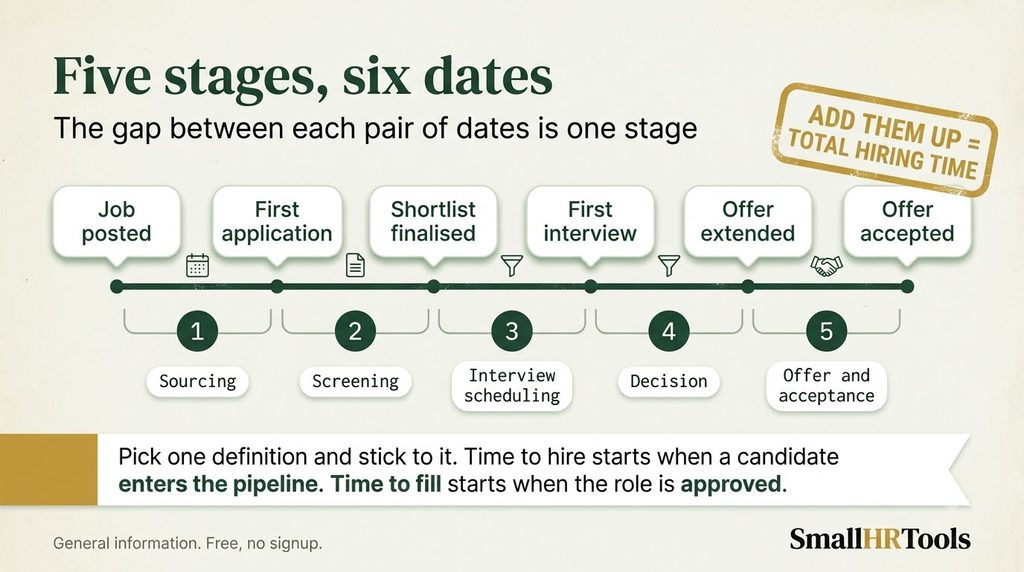
To find a bottleneck you need five dates for a recent hire:
- Date the job was posted
- Date the first application arrived
- Date the shortlist was finalised
- Date the first interview happened
- Date the offer was extended (and, if you have it, accepted)
The gap between each pair of dates is one stage. Add them all up and you have your total hiring time, which you can also check with the Time to Hire Calculator. Note that time to hire and time to fill are not the same thing. Time to fill starts when the role is approved, while time to hire starts when a candidate enters your pipeline. Pick one definition and stick to it so your numbers stay comparable.
Stage 1: Sourcing (posting the job to the first application)
What it is: The time between publishing a role and receiving your first real application.
Why it stalls:
- The job post is vague, so the right people do not recognise themselves in it.
- The role is posted on one channel only, usually whichever job board the owner already uses.
- The salary range is missing, which makes many candidates scroll past.
- The role is approved late, so the clock starts after the market has already moved on.
How to fix it:
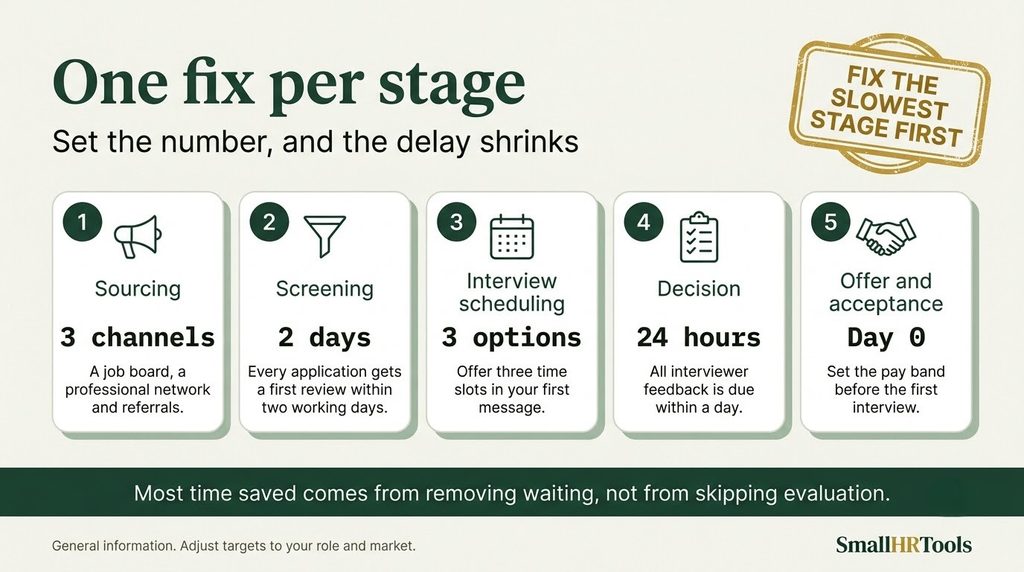
- Write the post for one specific person. Name the daily work, the reporting line, the location or remote arrangement, and the pay range. A clear post attracts fewer but better applicants, which also speeds up the next stage.
- Use at least three channels. For example, one job board, one professional network, and your own team’s referrals. Referrals are often the quickest of the three because the candidate arrives already vouched for.
- Keep a warm talent list. Every strong candidate you could not hire last time is a head start on the next role. A simple spreadsheet with name, role, and date last contacted is enough.
- Plan ahead. If you know growth is coming, use the Headcount Planning Calculator to forecast needs a quarter early, so sourcing starts before the pressure does.
Stage 2: Screening (first application to finished shortlist)
What it is: The time it takes to go from a pile of applications to a shortlist you are happy to interview.
Why it stalls:
- Nobody owns screening. Applications sit in an inbox because “someone” will get to it.
- There are no written criteria, so every resume review turns into a fresh debate.
- The hiring manager insists on reading every application personally.
- The recruiter or HR person is also handling payroll, onboarding, and compliance.
How to fix it:
- Write three to five must-have criteria before the job goes live. Anything not on the list is a bonus, not a filter. This turns screening into a quick yes or no.
- Set a screening deadline. For example, every application gets a first review within two working days of arriving. Put it in someone’s calendar, not just their intentions.
- Use a short screening call or form. Five minutes on salary expectations, notice period, and location filters out mismatches early and saves interview slots for people who can actually take the job.
- Check capacity honestly. If one person is screening for several open roles at once, delays are a workload problem, not a discipline problem. The Recruiter Capacity Calculator shows how many roles one recruiter can realistically handle.
Stage 3: Interview scheduling (shortlist to first interview)
What it is: The wait between finishing the shortlist and holding the first interview.
Why it stalls:
- Scheduling happens by back-and-forth messages, one slot at a time.
- Interviewers are senior people with packed calendars.
- Candidates who are currently employed can only talk before or after work.
- Different rounds are booked one after another instead of in a planned sequence.
How to fix it:
- Block interview windows in advance. Ask each interviewer to reserve two or three recurring slots a week. When a shortlist is ready, you are filling slots, not hunting for them.
- Offer candidates three time options in your first message. This removes at least two rounds of messages.
- Compress the loop. Where the role allows it, run two interview rounds on the same day, or combine the HR and manager conversations. Fewer separate events mean fewer places for delay to creep in.
- Keep the candidate informed. Silence is the fastest way to lose an interested candidate. A short update, even “we are still finalising times,” keeps them engaged.
Stage 4: Decision (first interview to offer)
What it is: The time from the first interview to the moment you decide who gets the offer.
Why it stalls:
- Interviewers share feedback late or only when chased.
- There is no scorecard, so opinions are compared by memory.
- The owner wants to “see a few more candidates” even though a strong one is already in hand.
- The decision needs several approvals and nobody is chasing them.
How to fix it:
- Use a simple scorecard. Score each candidate against the same three to five criteria immediately after the interview. It takes two minutes and makes comparison far faster.
- Set a feedback deadline. For instance, all interviewer feedback is due within 24 hours. Decide this when you book the interview, not after.
- Agree on the decision-maker up front. One person makes the call after hearing everyone’s input. Consensus is useful, but unanimity is slow.
- Know your walk-away point. If you already have a candidate who meets the must-have criteria, the cost of waiting for a “perfect” one is usually higher than the risk of acting. Waiting also adds to the real cost of the open role, which you can estimate with the Cost per Hire Calculator.
Stage 5: Offer and acceptance (offer extended to offer accepted)
What it is: The time between sending the offer and hearing a yes, plus the time it took you to prepare the offer in the first place.
Why it stalls:
- Compensation is decided only after the interviews, which means rounds of internal approval.
- The offer letter is written from scratch each time.
- The candidate is comparing other offers and you are the slowest to respond.
- The salary is lower than the candidate expected, and nobody discussed it earlier.
How to fix it:
- Set a pay band before you start interviewing. If you already know the range, the offer is a formality instead of a negotiation.
- Keep an offer letter template ready. Your own standard format, filled in with the candidate’s details, can go out the same day. If you are explaining the salary structure to the candidate, the CTC Breakup Calculator and In-Hand Salary Calculator help show what lands in their account each month, which often prevents last-minute confusion.
- Raise salary expectations early. Ask in the screening stage, not at the offer stage. A mismatch discovered on day three costs far less than one discovered on day thirty.
- Track how many offers are accepted. If many candidates say no after you have invested weeks in them, the problem may not be speed at all. Check your numbers with the Offer Acceptance Rate Calculator.
How to find your biggest bottleneck
Take your last two or three hires and write the number of days each stage took. Look for the stage that is consistently the largest. That is where one change will save the most time.
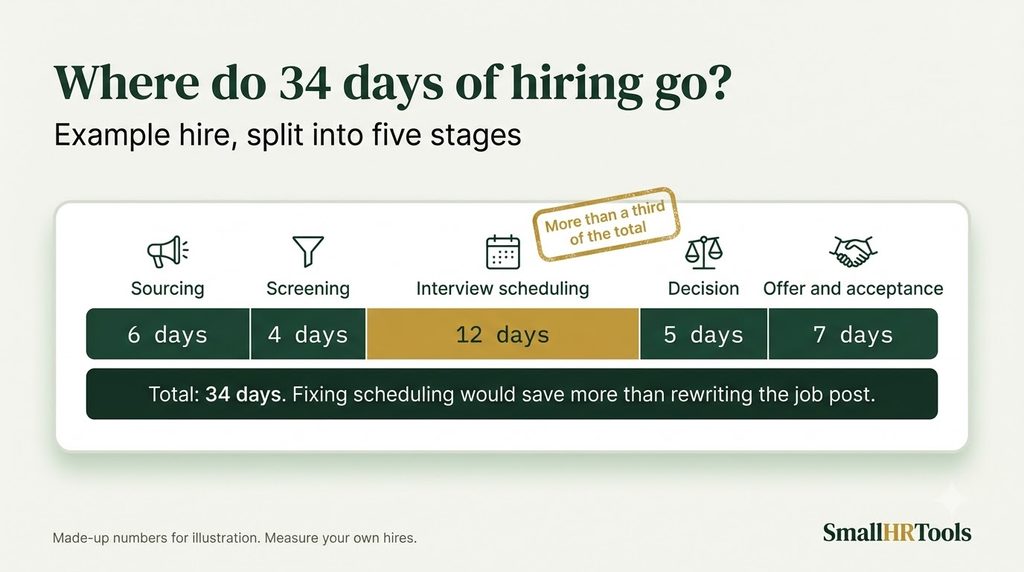
A small example, with made-up numbers for illustration:
| Stage | Days |
|---|---|
| Sourcing | 6 |
| Screening | 4 |
| Interview scheduling | 12 |
| Decision | 5 |
| Offer and acceptance | 7 |
| Total | 34 |
In this example, interview scheduling takes more than a third of the total time. Fixing that one stage with blocked calendar windows would help more than rewriting the job post or adding a new job board.
The Speed-to-Hire Calculator does this comparison for you: enter your five dates and it shows your stage-by-stage breakdown and highlights where you are losing the most time.
Why this matters beyond the open role
Slow hiring does not only delay a start date. It also puts extra load on the people already on your team, and prolonged overload can push good employees toward leaving. If your team is already stretched, it is worth looking at your employee turnover and retention rate at the same time, because a slow hiring process and a high exit rate tend to feed each other.
Frequently asked questions
What is a good hiring speed for a small business?
It depends on the industry and the seniority of the role. Entry-level roles generally move faster than senior ones. The most useful comparison is your own process over time: aim to shorten the slowest stage first and watch your total fall.
Which stage is usually the slowest?
There is no universal answer, which is exactly why measuring matters. Many small businesses find the delay is in scheduling or decision-making rather than in finding candidates.
Should I hire faster even if it means a less thorough process?
Speed and quality are not opposites. Most of the time saved comes from removing waiting time (unanswered messages, late feedback, unscheduled interviews), not from skipping evaluation.
How often should I measure my hiring speed?
After every hire is ideal, since the dates are fresh. At minimum, review it quarterly.
Conclusion
Slow hiring is usually a series of small waits, not one large failure. Break your process into the five stages, find the one that takes the longest, and fix that first. Then measure again on your next hire.
Ready to see your own numbers? Try the Speed-to-Hire Calculator and find your bottleneck in under a minute.