
Short answer: an employee is covered by ESI if their gross monthly wages are ₹21,000 or less (₹25,000 for persons with disability) and they work in a covered establishment – broadly, factories and notified establishments with 10 or more employees (20 in some states and categories). The contribution is 0.75% of gross from the employee and 3.25% from the employer. The part everyone gets wrong: coverage is locked for a full contribution period – so an employee whose salary crosses ₹21,000 mid-period keeps contributing until the period ends. Here’s how it actually works on a payroll.
Who is covered
Three tests, all must pass:
- Establishment test. ESI applies to factories and notified establishments (shops, hotels, restaurants, cinemas, road transport, newspapers, private medical and educational institutions in many states) once they reach the employee threshold – 10 employees in most states and categories, 20 in some. The count includes all employees, not just those under the wage ceiling. Once registered, an establishment generally stays covered even if headcount later dips.
- Wage test. Gross monthly wages ≤ ₹21,000 (₹25,000 for an employee with a disability). “Wages” here means gross – basic, DA, HRA, and most allowances – not just basic pay, and not CTC.
- Geography test. The establishment must be in an ESI-implemented area. Coverage is now near-universal across districts, but newly notified areas get phase-in dates – check the ESIC website for your district if you’re rural.
What the employee gets in return is substantial and often under-sold: full medical care for self and dependants at ESIC facilities, sickness benefit at ~70% of wages for up to 91 days a year, 26 weeks of maternity benefit at full wages, disablement pension, and dependants’ benefit – for a personal contribution of at most ₹157/month.
The contribution math
| Party | Rate | On ₹18,000 gross |
|---|---|---|
| Employee | 0.75% | ₹135 |
| Employer | 3.25% | ₹585 |
| Total | 4.00% | ₹720/month |
Two payroll details: employees earning an average daily wage up to ₹176 are exempt from their 0.75% share (the employer still pays 3.25%), and contributions are due by the 15th of the following month. Run any salary through the ESI Calculator to see both sides instantly, or see where ESI sits inside the full salary structure with the CTC Breakup Calculator and In-Hand Salary Calculator.

Contribution periods: the rule that catches everyone
ESI runs on two fixed six-month contribution periods:
| Contribution period | Corresponding benefit period |
|---|---|
| 1 April – 30 September | 1 January – 30 June (following year) |
| 1 October – 31 March | 1 July – 31 December |
The rule: eligibility is tested at the start of the contribution period, and coverage continues to the end of that period regardless of salary changes within it.
Worked example: the mid-year increment
Sunita earns ₹20,000 gross. On 1 July she gets an increment to ₹23,000 – above the ceiling.
- July, August, September: she is still covered and contributions continue – but now calculated on her full ₹23,000 gross (employee ₹173, employer ₹748). Crossing the ceiling mid-period does not stop deductions; it only schedules her exit.
- 1 October: the new contribution period begins, her wages exceed ₹21,000, so she exits ESI coverage.
- Benefits tail: because she contributed in the April-September period, she remains entitled to benefits until 30 June of the following year – the benefit period lags the contribution period by roughly a quarter.
The employer mistakes here are symmetrical and both costly: stopping deductions in July (short-payment, interest at 12% p.a. plus damages up to 25%) or continuing deductions past September (unauthorised deduction from wages). Put a calendar reminder on 1 April and 1 October to re-test every employee against the ceiling.

Worked example: the new joiner
Arif joins on 12 August at ₹19,500 gross. He’s registered from day one – there is no waiting period for coverage – and contributions run for August and September. His initial eligibility for cash benefits (like sickness benefit) requires a minimum contribution history (broadly, contributions for about half the working days of the period), so very recent joiners have medical care immediately but earn cash-benefit eligibility as their contribution history builds.
ESI vs EPF: don’t confuse the ceilings
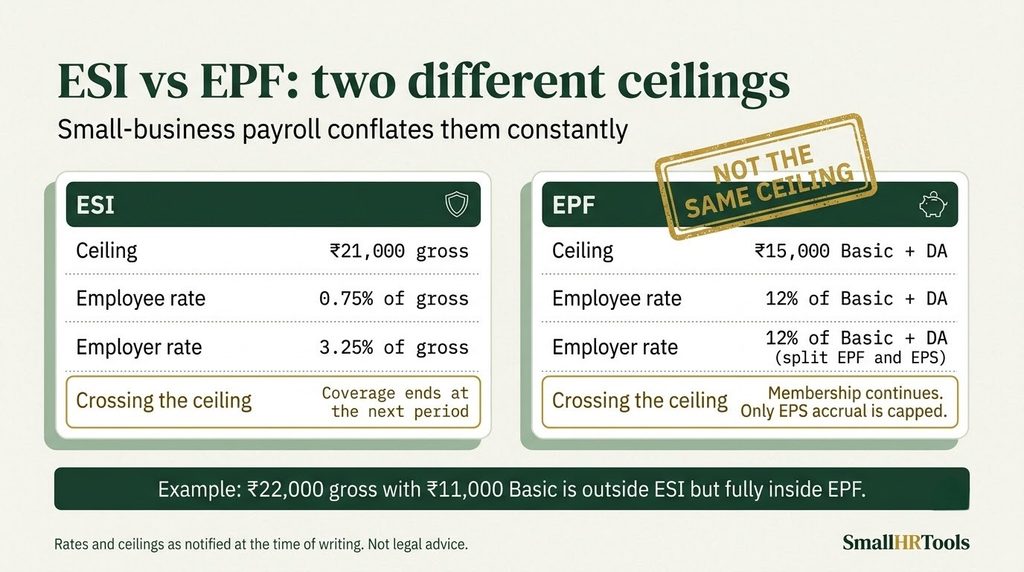
Small-business payroll conflates these constantly:
| ESI | EPF | |
|---|---|---|
| Ceiling | ₹21,000 gross – above it, exit at period end | ₹15,000 Basic+DA – above it, membership continues once enrolled |
| Employee rate | 0.75% of gross | 12% of Basic+DA |
| Employer rate | 3.25% of gross | 12% of Basic+DA (split EPF/EPS) |
| Crossing the ceiling | Coverage ends (next period) | Coverage continues; only EPS accrual is capped |
An employee at ₹22,000 gross with ₹11,000 basic is outside ESI but fully inside EPF. Model the retirement side with the EPF Calculator.
Employer compliance checklist
- Register within 15 days of becoming coverable (Form 01 via the ESIC portal); you’ll get a 17-digit code number.
- Register every eligible employee and issue their Insurance Number / Pehchan card details – including contract and casual workers on your premises (the principal employer is liable for contractors’ compliance).
- Pay by the 15th of the following month; file the half-yearly return of contributions.
- Re-test at 1 April and 1 October – the only two dates coverage status can change for salary reasons.
- Keep an accident register and report employment injuries within 24 hours – the disablement benefits only work if the paper trail exists.
Frequently Asked Questions – FAQs
/fq
Is ESI calculated on CTC?
No – on gross wages actually payable. Employer contributions (PF, ESI itself) and gratuity provisions in CTC are excluded from the wage base.
Does washing allowance or overtime count as wages?
Overtime counts for contribution (pay ESI on it) but not for the eligibility ceiling test – a ₹20,000 employee doing ₹2,000 of overtime stays covered. A true washing allowance is excluded from wages.
Can an employee opt out if they have private insurance?
No. ESI is statutory – neither employer nor employee can opt out while the eligibility tests are met.
We just hit 10 employees. When does ESI start?
From the date you reach the threshold – registration is due within 15 days, and liability runs from that date, not from when you get around to registering.
What if we’re in a state with a 20-employee threshold?
Thresholds differ by state and establishment type (factories vs shops). Check the ESIC notification for your state – and note that voluntarily staying just under the threshold by using contractors doesn’t work, since contractor employees on your premises count toward the principal employer’s number in most scenarios.
Calculators referenced: ESI · CTC Breakup · In-Hand Salary · EPF · Payslip Generator. Rates and the ₹21,000 ceiling are as notified at the time of writing; ESIC revises thresholds by notification – verify current values before running payroll. Not legal advice.