
The first hire for a small e-commerce team should take over work that is repetitive, tied to a deadline, and doesn’t need you. For most online stores, that means packing orders and answering customer messages, not marketing and not a “manager.”
Most stores begin with one person doing everything: sourcing, listing products, running ads, packing parcels, replying to “where is my order?” at 11 pm. Growth stalls when that person is the only one who can do any of it. The way out is to hand work off in the right order, with enough structure that the work doesn’t fall back on you.
List the work before you pick job titles
For one normal week, write down every task you do, how many hours it takes, and whether it has to happen at a fixed time. Packing before the courier pickup is fixed. Updating a product description is not.
Most owners find that three or four tasks eat the bulk of the week. Those are what to hand off first. Once you have the hours, the Headcount Planning Calculator turns them into a number of people, which is more reliable than a feeling that you’re “too busy.”
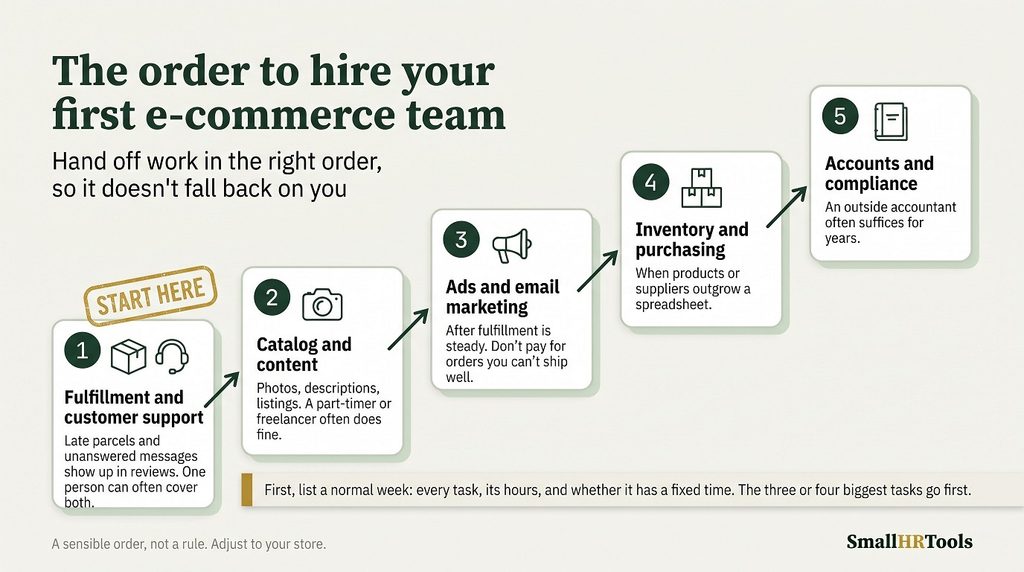
A sensible order of hiring
The right order depends on your store, but this one works for many:
- Fulfillment and customer support. Late shipping and unanswered messages show up in reviews and repeat orders. At first, one person can often cover both.
- Catalog and content. Photos, descriptions, and listing updates across your site and marketplaces. A part-timer or freelancer usually does fine here.
- Ads and email marketing. Hire this after fulfillment is steady. Paying to bring in orders you can’t ship well wastes money.
- Inventory and purchasing. This becomes its own job when the number of products or suppliers outgrows a spreadsheet and your memory.
- Accounts and compliance. Most small stores use an outside accountant for years before they need someone in-house.
Employee, freelancer, or agency
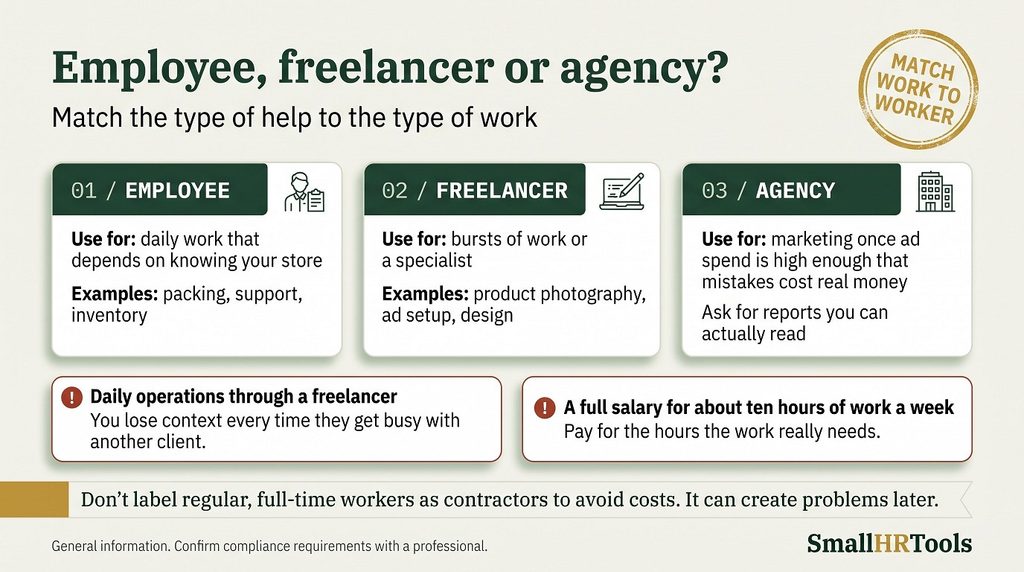
Use an employee for work that happens every day and depends on knowing your store: packing, support, inventory. Use a freelancer for work that comes in bursts or needs a specialist, like product photography, ad setup, or design. An agency makes sense for marketing once ad spend is high enough that mistakes cost real money. Ask for reports you can actually read.
Two mistakes come up often. One is running daily operations through a freelancer, then losing context every time they get busy with another client. The other is putting someone on a full salary for work that amounts to ten hours a week.
If you hire often, work out what each hire really costs with the Cost per Hire Calculator. If roles stay open for weeks, the Speed-to-Hire Calculator shows which stage of your process is slowing you down.
Plan for the peaks
E-commerce demand comes in spikes. A festive sale or a big marketplace event can multiply your order volume for a few days, and then it drops. Hiring permanent staff for a three-week spike leaves you paying for them in the quiet months.
A few ways to cover a peak without that:
- Hire temporary packers early enough to train them. Untrained staff on day one means wrong items and damaged parcels.
- Pre-pack your fastest-selling products before the sale starts.
- Move some products to dropshipping, where the supplier packs and ships the order directly. You avoid hiring extra packers for those items, though you give up some control over packing quality and delivery times. This beginner’s guide to dropshipping explains how the model works.
- Cross-train existing staff so support can help with packing and the reverse.
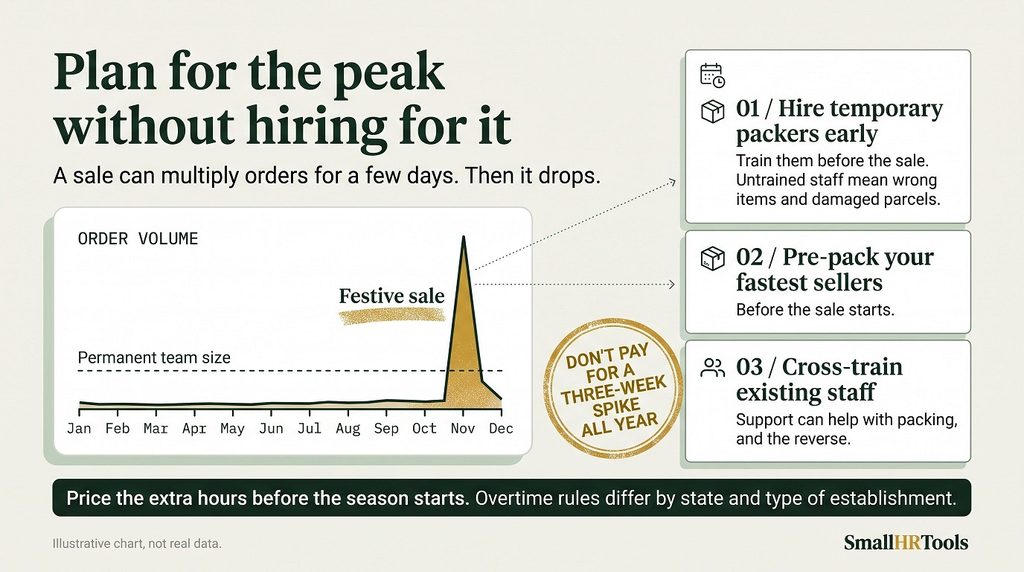
Extra hours cost money, so price them before the season starts. The Overtime Calculator helps, and if you pay daily wages to some people and monthly salaries to others, the Salary to Hourly Calculator puts everyone on the same footing. Overtime rules differ by state and by type of establishment, so check what applies to you before promising a rate.
Make the work run without you
A small team runs well when people don’t need to ask you what to do. Three habits get you most of the way.
Write one-page instructions for repeat tasks. How to pack a fragile order. How to handle a return. What to tell a customer when the courier is delayed. A few photos or a short screen recording beat a long document that nobody opens.
Give each number an owner. One person is responsible for on-time dispatch, another for return rate, another for ad spend against revenue. When a number slips, you know who to talk to.
Hold a short weekly meeting. Thirty minutes, looking at those numbers, ending with one thing to fix before the next meeting. More than that and the meeting becomes the job.
For a broad view of how the team is doing, the Workforce Productivity Calculator and the Revenue per Employee Calculator are useful. Treat them as rough guides. A store selling low-margin items will look very different from one selling high-margin items, so compare against your own past figures first.
Pay and compliance
New hires compare offers by take-home pay, so be ready to explain it. The CTC Breakup Calculator and the In-Hand Salary Calculator show how a package turns into what lands in someone’s bank account.
Statutory obligations depend on how many people you employ, what they earn, and which state you operate in. That can bring in EPF, ESI, Professional Tax, and the Labour Welfare Fund, along with state registration under shops and establishments rules. India’s labour laws have been changing, so confirm current thresholds with an accountant or labour compliance professional before you decide you are in or out. Also be careful about labelling regular, full-time workers as contractors to avoid these costs, since that can create problems later.
Keep the people you have trained
Packers and support staff are easy to hire and expensive to lose, because every exit means retraining while orders keep arriving. Track how often it happens with the Employee Turnover Calculator and the Retention Rate Calculator.
What keeps people in a small team is mostly basic: salary on time, shifts they can plan around, and a visible next step. A good packer can become a dispatch lead. A good support person can take over customer experience. If nobody can see a next step, the best ones leave for the first better offer.
Absence tends to spike around festivals, which is also when you are busiest. Check your pattern with the Absenteeism Rate Calculator, and use the Leave Balance Calculator to plan time off before the rush begins instead of during it.
FAQs – Frequently Asked Questions
Who should I hire first for a small ecommerce business?
Hire for fulfillment and customer support first. Late shipping and unanswered messages show up in reviews and repeat orders, and one person can often cover both at the start. Marketing hires work better once dispatch is steady.
How many people does a small ecommerce team need?
It depends on your order volume and how many hours the work takes, so there is no fixed number. List every task you do in a normal week with its hours, then convert that into headcount with the Headcount Planning Calculator.
Should I hire employees, freelancers, or an agency?
Use employees for daily work that depends on knowing your store, like packing, support and inventory. Use freelancers for bursts of specialist work such as photography, design or ad setup. An agency makes sense for marketing once ad spend is high enough that mistakes get expensive.
How do I handle festive season peaks without hiring permanent staff?
Hire temporary packers early enough to train them, pre-pack your fastest-selling products, and cross-train existing staff so support can help with packing. Price the extra hours before the season starts with the Overtime Calculator.
Do I need to register for EPF and ESI for my ecommerce team?
It depends on how many people you employ, what they earn and which state you operate in. These rules have been changing, so confirm the current thresholds with an accountant or labour compliance professional. Don’t label regular full-time workers as contractors to avoid these costs.
How do I manage a small team without being the bottleneck?
Write one-page instructions for repeat tasks, give each key number (dispatch time, return rate) an owner, and hold a short weekly meeting that ends with one thing to fix. People stop asking you what to do when the answer is already written down.
How do I keep trained staff from leaving?
Pay on time, keep shifts predictable, and show a next step, such as a packer moving up to dispatch lead. Track your exits with the Employee Turnover Calculator so you can see if it’s getting worse.