
Employee financial wellness means your people can pay their bills, handle a surprise expense and put a little aside without constant worry.
That sounds like a private matter, and mostly it is. But money stress doesn’t stay at home. Someone waiting for payday to cover rent spends part of the workday doing sums in their head. Someone facing a big unexpected bill with no savings asks for an advance, takes a second job, or starts looking for a company that pays a few thousand more a year. In a small business, where each person covers a lot, you feel it in focus and attendance, and sometimes in a resignation letter.
Improving employee financial wellness doesn’t need a big budget. It comes down to paying on time, making pay easy to understand, and giving people a safe way through emergencies.
Why employee financial wellness matters to a small business
A large company can absorb a few exits and a few distracted months. A team of fifteen can’t. When one packer, stylist or accountant is off, distracted or gone, the work lands on everyone else.
Money stress shows up as distracted work and unplanned leave, and eventually as resignations over small pay gaps. It also leaves a trail you can read. If three people ask for an advance in the same month, or payslip questions pile up right after payday, the problem is usually in how pay is set up or explained. That is cheaper to fix than to keep handling as exceptions.
Pay on time and make pay easy to read
Pay is where employee financial wellness starts. Pay on the same day every pay period. If a delay is unavoidable, tell people before payday, not after. Rent, loan repayments and childcare fall on fixed dates, and a late payment pushes people to borrow at bad rates, through overdrafts, credit cards or payday lenders.
Give everyone a payslip (a pay stub in the US) every pay period. If you don’t have payroll software yet, the Payslip Generator is a quick way to produce one, though a payroll provider will also handle tax withholding and filings for you.
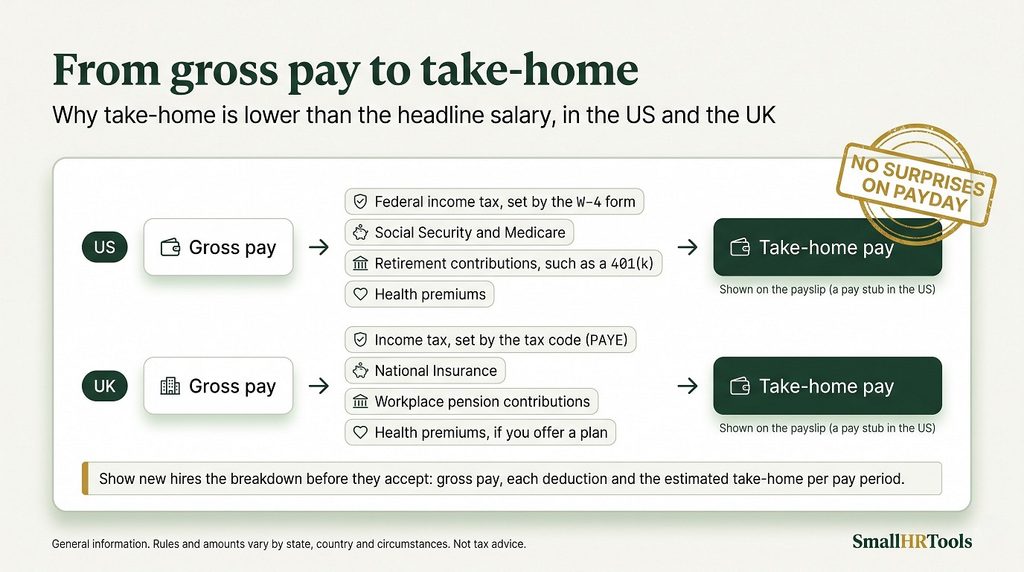
New hires often compare offers by headline salary and are surprised when take-home is lower after income tax, Social Security and Medicare (US) or National Insurance (UK), retirement contributions and health premiums. Show them the breakdown before they accept: gross pay, each deduction, and the estimated take-home per pay period. Most payroll software can produce this estimate.
Errors in overtime, holiday pay and final pay are easy to make, and employees remember them. In the US, non-exempt employees generally must be paid time and a half for hours over 40 in a week, and some states add their own rules. In the UK there is no general right to overtime pay, but holiday pay generally has to include regular overtime. Confirm what applies to you with your payroll provider or an employment adviser.
Explain the benefits people already have
Many employees don’t know how their benefits actually work: that a 401(k) match (US) or a workplace pension contribution (UK) is part of what they earn and builds over time, what their health coverage includes, and how paid time off and sick pay accrue. Spend fifteen minutes on this at onboarding and again once a year. Rules, limits and thresholds change, so check current figures before you quote a number to anyone.
Tax withholding is worth a mention too. In the US, the W-4 form tells you how much federal income tax to withhold from each paycheck; in the UK, the tax code HMRC issues does the same job under PAYE. Many people never revisit either after a life change such as a new job, a second income or a marriage, and a wrong form or code can mean a surprise bill or less take-home pay than they need. Encourage people to check theirs, using the IRS Tax Withholding Estimator in the US or their personal tax account on GOV.UK in the UK.
Give people a way through emergencies
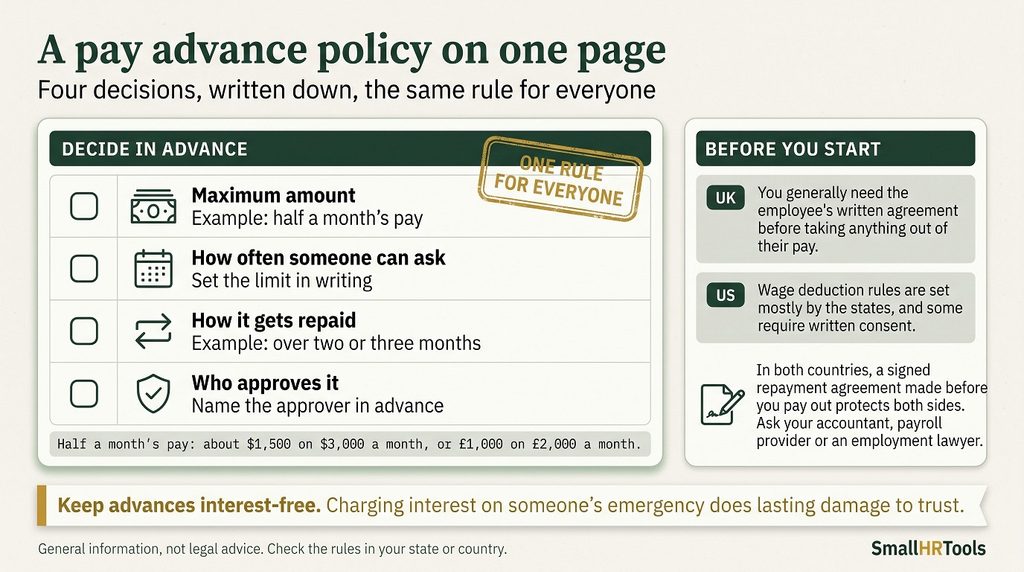
The most useful thing a small employer can set up is a written pay advance policy. Decide the maximum amount, how often someone can ask, how it gets repaid and who approves it. For example, you might cap it at half a month’s pay (about $1,500 for someone earning $3,000 a month, or £1,000 for someone earning £2,000), repaid over two or three months. Those numbers are yours to choose. What matters is that the rule exists, so advances don’t depend on who asks or who you like best.
Check the rules on deductions before you start. In the UK, you generally need the employee’s written agreement before taking anything out of their pay. In the US, wage deduction rules are set mostly by the states, and some require written consent, so ask your accountant, payroll provider or an employment lawyer how they apply to you. In both countries, a signed repayment agreement, made before you pay the advance, protects both sides. Keep advances interest-free, since charging interest on someone’s emergency does lasting damage to trust.
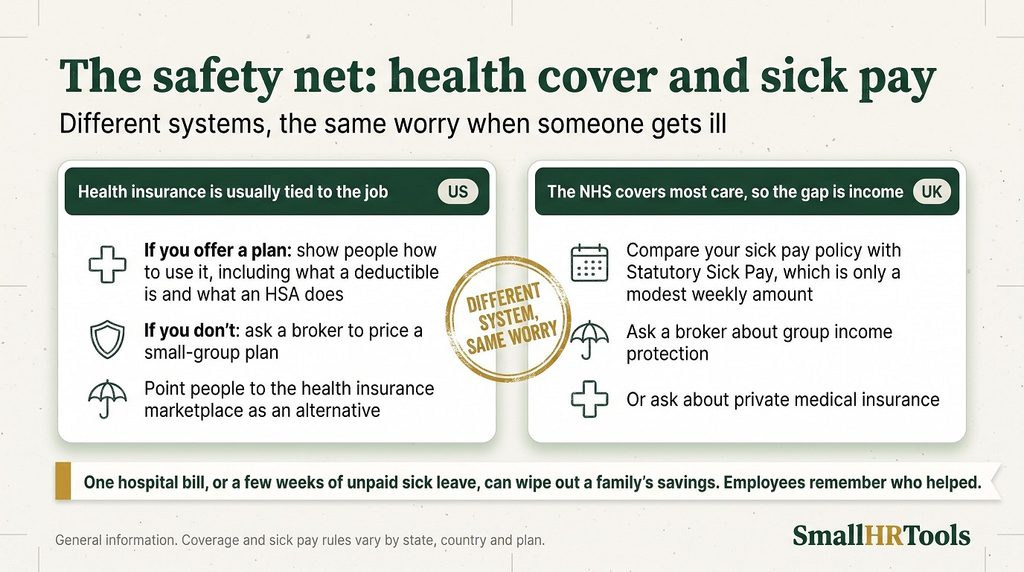
Health coverage matters too. In the US, health insurance is usually tied to the job, so if you offer a plan, make sure people know how to use it, including what a deductible is and what an HSA does. If you don’t offer one, ask a broker to price a small-group plan, and point people to the health insurance marketplace as an alternative. In the UK, the NHS covers most care, so the bigger gap is usually income when someone is off sick. Compare your sick pay policy with Statutory Sick Pay, which is only a modest weekly amount, and ask a broker about group income protection or private medical insurance. One hospital bill, or a few weeks of unpaid sick leave, can wipe out a family’s savings, and employees remember who helped.
Teach the basics and stop there
A good employee financial wellness plan at a small company is a couple of short sessions a year, not an app. Thirty to forty-five minutes is enough: how to read a payslip, how tax withholding works, how to build a small emergency fund, what term life insurance does, and how to spot scams such as fake loan offers, phishing texts and payment-app fraud. Make attendance voluntary, and bring in an outside trainer if nobody on your team is comfortable running it. The Training Budget Calculator helps you size the spend, and the Training ROI Calculator helps you check whether it paid off.
Keep it educational. Recommending specific stocks, funds or other investments can fall under the rules for registered investment advisers in the US and for regulated advice in the UK, so don’t have HR do it. And never ask employees to disclose their income, loans or savings.
If gold comes up in a session, the useful part to explain is how bullion is priced: a live spot price, plus a premium the dealer adds on top. The London Gold Centre homepage has a short explainer on the difference. It’s a UK dealer that quotes in pounds, so use it to show how pricing works, not as a place to buy.
Review pay before people ask
A raise that doesn’t keep up with living costs is a pay cut in practice. Many small businesses only give increases when someone threatens to leave, which rewards the loudest person and overlooks quiet performers. Set a review date each year, and check your lowest pay rates whenever minimum wages change (the National Minimum Wage and National Living Wage in the UK; federal, state and sometimes city minimums in the US). The Salary Hike Calculator turns a percentage into an actual pay figure, and the Salary to Hourly Calculator lets you compare hourly, weekly and salaried workers on the same basis. Fair, predictable pay reviews do more for employee financial wellness than most one-off perks.
How to tell if it’s working
There’s no single score for employee financial wellness, but you can watch what moves with it. Run a short anonymous survey twice a year with a few plain statements, such as “I understand how my pay is calculated” and “I could cover an unexpected expense without borrowing.” Score the results with the Employee Satisfaction Score Calculator, the eNPS Calculator or the Engagement Index Calculator. In a small team, report results as group figures and don’t try to work out who said what.
Then watch the numbers that sit next to it: absence (Absenteeism Rate Calculator), exits (Employee Turnover Calculator and Retention Rate Calculator), and how many advance requests and payslip queries you get each month. Compare against your own earlier figures. Each of these moves for other reasons too, so treat them as clues, not proof.
FAQs – Employee Financial Wellness
What is employee financial wellness?
Employee financial wellness is how well your people can manage their money: pay bills on time, handle a surprise expense and save a little. At work, it covers getting paid correctly and on time, understanding the payslip and benefits, and having a safe option when an emergency hits.
Why does financial wellness matter for a small business?
Money stress tends to show up as distracted work, unplanned leave and resignations over small pay gaps. In a small team, each of those lands on a few people. Fixing pay timing and clarity costs far less than replacing someone, and the Cost per Hire Calculator shows what a replacement really costs.
How can a small business improve employee financial wellness on a low budget?
Pay on a fixed day, give clear payslips, explain your retirement and health benefits at onboarding, and write a pay advance policy. None of these cost much, and together they remove most of the common money worries.
Should I offer pay advances to employees?
It can help, but write the policy down first: the maximum amount, how often someone can ask, the repayment period and who approves it. Check the rules on wage deductions (written agreement in the UK, state rules in the US), and keep advances interest-free.
Can HR give employees investment advice?
Keep sessions educational. Recommending specific stocks, funds or other investments can fall under the rules for registered investment advisers in the US and for regulated advice in the UK. Teach how to read a payslip, build an emergency fund and avoid scams, and point people to a regulated adviser for investment decisions.
Do I have to give employees a payslip?
In the UK, yes: employees and workers have a legal right to an itemised payslip on or before payday. In the US, federal law doesn’t require pay stubs, but most states do, so check yours. Even where it isn’t required, a clear payslip every pay period is worth doing, and the Payslip Generator makes it quick.
How do I measure whether it’s working?
Run a short anonymous survey twice a year and track absence, turnover and the number of advance requests. Score the survey with the Employee Satisfaction Score Calculator or the eNPS Calculator, and compare against your own earlier results.