
HR challenges in the beauty industry start with an awkward fact: in a salon or spa, clients often follow the stylist, not the business. When a senior stylist resigns, a chunk of revenue can walk out with them. Add commission pay, long days, wedding-season rushes and constant retraining on new products, and an owner ends up running an HR department without ever planning to.
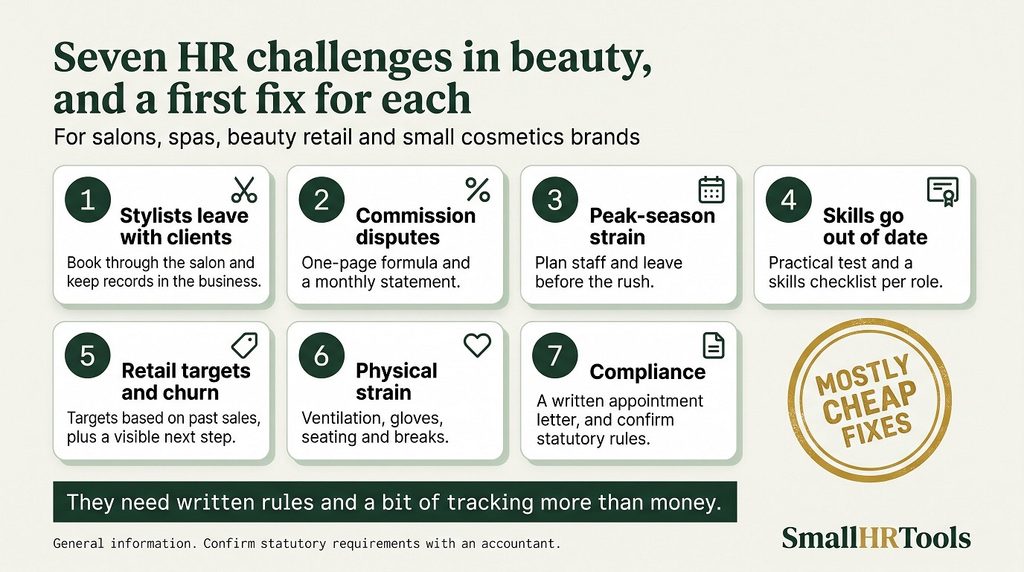
These HR challenges in the beauty industry show up in salons, spas, beauty retail stores and small cosmetics brands, in different proportions. The fixes are mostly cheap. They need written rules and a bit of tracking more than money.
Stylists leave and take clients with them
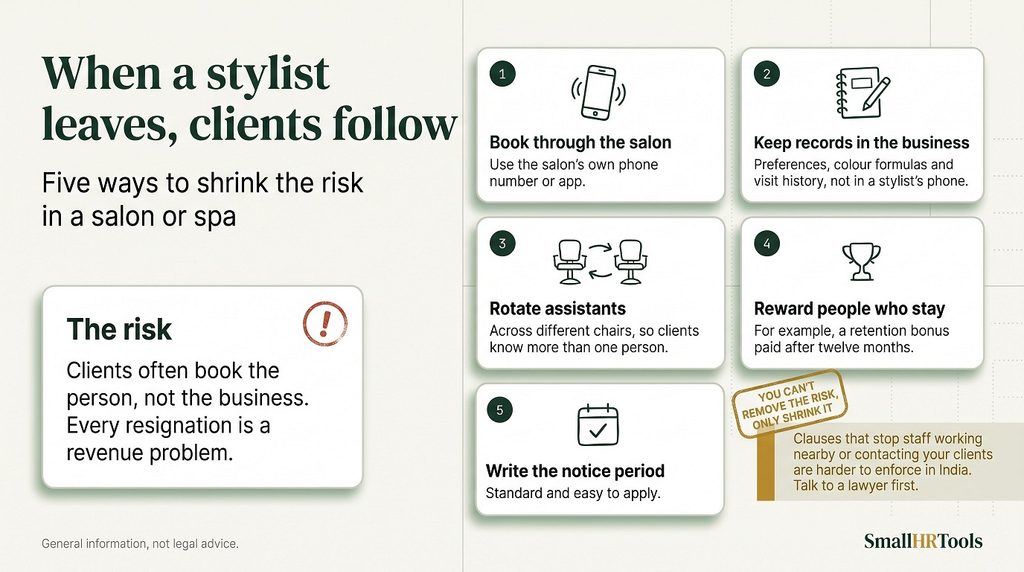
Skilled stylists, makeup artists and therapists are in demand, and a better offer from the salon down the road is easy to find. If clients book a person rather than your salon, every resignation is a revenue problem.
You can’t remove that risk, but you can shrink it. Take bookings through the salon’s own phone number or app, and keep client records (preferences, past colour formulas, visit history) in the business’s system rather than in a stylist’s phone. Rotate assistants across different chairs so clients know more than one person. Reward people who stay, for example with a retention bonus paid after twelve months, so leaving costs them something.
Contracts help a little. A written notice period is standard and easy to apply. Clauses that stop someone from working nearby or contacting your clients after they leave are harder to enforce in India, so talk to a lawyer before relying on them.
Measure the problem before you try to fix it. The Employee Turnover Calculator and Retention Rate Calculator show how often people leave, and the Cost per Hire Calculator shows what each exit costs to replace.
Commission pay causes more arguments than salary
Many beauty businesses pay a base plus a percentage of services, sometimes with a product-sales incentive and shared tips. The arguments start over what counts. Is the percentage taken before or after a discount? What happens to a package the client bought last month? Who gets credit when two people worked on the same bridal booking?
Write the formula on one page and settle those questions in advance. Give each person a monthly statement listing every service that counted, so they can check it against their own records. Most disputes fade once the numbers are visible.
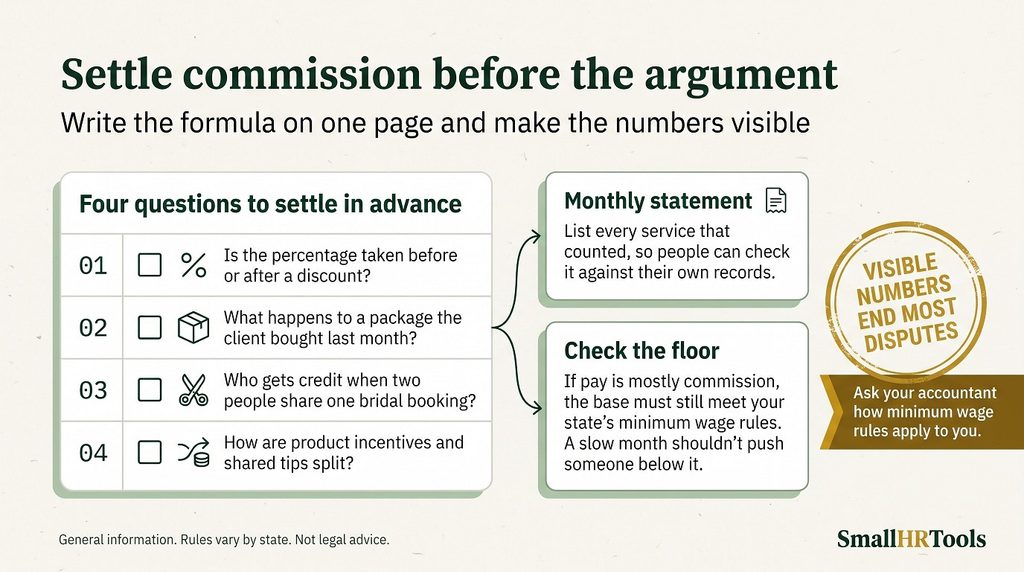
Check the floor too. If someone’s pay is mostly commission, the base still has to meet the minimum wage rules for your state, and a slow month shouldn’t push them below it. Ask your accountant how those rules apply to you. The Salary to Hourly Calculator shows what a month’s earnings work out to per hour. When you make an offer, the CTC Breakup Calculator and In-Hand Salary Calculator help candidates see their actual take-home, which prevents a lot of confusion.
Peak season breaks schedules
Seasonality is the part of HR management in the beauty industry that most owners learn the hard way. Wedding season and festivals like Diwali bring weeks of full diaries and late finishes, followed by quiet stretches. Long days in peak weeks wear people down.
Plan before the rush. Confirm who is available, bring in freelance makeup artists and part-time assistants for bridal dates, and agree on leave in advance instead of approving it case by case. Price overtime before you promise it with the Overtime Calculator, and check who has leave left with the Leave Balance Calculator. If absence climbs after a peak, the Absenteeism Rate Calculator shows the pattern.
Skills go out of date quickly
Colouring techniques, treatments, tools and product ranges keep changing, and people arrive with certificates of very different value. Don’t hire on the certificate alone. Ask candidates to do a short practical service on a model, and score everyone against the same few points. Keep a skills checklist for each role (balayage, bridal makeup, facials, nail extensions) so you can see who can do what and where you’re thin.
Then spend training money where the checklist shows gaps. The Skill Gap Estimator helps you find them, the Training Budget Calculator sizes the spend, and the Training ROI Calculator checks whether it paid off.
Retail advisors deal with targets and churn
HR challenges in the beauty industry look different at a store counter than in a salon. Advisors carry sales targets, stand through long shifts and need to know hundreds of products. Targets that look unreachable make people quit. Set them against what the store actually sold over the past few months, mix an individual incentive with a team one so advisors help each other instead of competing for the same customer, and run product training before each launch, not after. Give your best advisors a visible next step, such as counter lead or store trainer.
If your store sells a private label range, ask the manufacturer for ingredient sheets and formulation notes to build that training from. This list of skincare manufacturers in China is a starting point if you’re still choosing a supplier, though check import rules and minimum order quantities first.
To read morale, a short survey scored with the eNPS Calculator or the Employee Satisfaction Score Calculator works better than guessing.
The job is physical
Physical strain is one of the quieter HR challenges in the beauty industry. Hairdressers and therapists stand for hours, handle chemicals and keep their hands in water all day. Sore feet, irritated skin and back pain are why good people cut their hours or leave.
The basic fixes cost little: ventilation where colour and nail products are used, gloves, proper stools or seating, breaks between long services, and a stocked first-aid kit. Hygiene rules belong here too. Customers notice them, and so does your staff.
Hiring takes too long
An empty chair earns nothing, so slow hiring is one of the HR challenges in the beauty industry that hits revenue directly. Two things shorten it. Keep a list of freelancers and strong candidates you couldn’t hire last time, and ask your best staff for referrals, since a good stylist usually knows other good stylists. Then look at your own process. If the practical test waits two weeks for a free slot, that’s where the time goes.
The Time to Hire Calculator and Speed-to-Hire Calculator show which stage is slowest, and the Offer Acceptance Rate Calculator shows whether candidates are saying yes. Before a busy season, the Headcount Planning Calculator helps you work out how many people you’ll need.
Compliance is easy to skip and costly to ignore
Of all the HR challenges in the beauty industry, compliance is the one owners put off longest, and it’s cheapest to sort out early. Many small salons run on cash and verbal agreements. A written appointment letter covering the role, pay structure, working hours and notice period saves arguments later.
Statutory requirements, including shops and establishments registration, EPF, ESI, Professional Tax and the Labour Welfare Fund, depend on your headcount, pay levels and state. The rules have been changing, so confirm the current position with an accountant.
Beauty workforces are often mostly women. The Prevention of Sexual Harassment (POSH) Act generally requires an internal complaints committee once a workplace has ten or more employees. Confirm how it applies to your setup, including part-timers and freelancers.
Frequently Asked Questions
What are the biggest HR challenges in the beauty industry?
The main ones are stylists leaving and taking clients with them, commission disputes, uneven demand around wedding season and festivals, keeping skills current, physical strain on staff, slow hiring and compliance. Which one hurts most depends on whether you run a salon, a spa or a retail counter.
How do I stop stylists from taking clients when they leave?
You can’t remove the risk, but you can shrink it. Take bookings through the salon’s phone number or app, keep client records in the business’s system, and rotate assistants so clients know more than one person. A retention bonus paid after twelve months also gives people a reason to stay. Non-compete and non-solicit clauses are hard to enforce in India, so speak to a lawyer before relying on them.
How should I structure commission for salon staff?
Write the formula on one page and settle the edge cases in advance: whether the percentage applies before or after discounts, how packages are credited, and who gets credit when two people work on one booking. Give each person a monthly statement of the services that counted. Check that the base pay still meets minimum wage rules for your state, and use the Salary to Hourly Calculator to see what a month’s earnings work out to per hour.
How do I staff a salon for wedding season and festivals?
Plan before the rush. Confirm who is available, bring in freelance makeup artists and part-time assistants for bridal dates, and agree on leave in advance. Price overtime before you promise it with the Overtime Calculator, and check who has leave left with the Leave Balance Calculator.
How do I check whether a stylist or makeup artist is actually skilled?
Don’t hire on the certificate alone. Ask the candidate to do a short practical service on a model and score everyone against the same few points. Keep a skills checklist for each role so you can see who can do what and where you’re thin. The Skill Gap Estimator helps with that last step.
Do small salons need to register for EPF, ESI and Professional Tax?
It depends on your headcount, what your staff earn and your state, and the rules have been changing. Shops and establishments registration usually applies as well. Confirm the current position with an accountant instead of assuming you’re in or out.
Does the POSH Act apply to a small salon or spa?
The Prevention of Sexual Harassment (POSH) Act generally requires an internal complaints committee once a workplace has ten or more employees. How it applies to part-timers and freelancers, and what smaller setups need to do, is worth confirming with a lawyer or labour compliance professional.
How can I measure whether my HR problems are getting better?
Track a few numbers over time: how often people leave (Employee Turnover Calculator), how long hiring takes (Time to Hire Calculator), and how staff feel (eNPS Calculator). Compare against your own earlier figures first.